


Border War! Vermont vs. New Hampshire Skiing Part 14 – Cranmore Mountain
—by Jay Flemma—
NORTH CONWAY, NH – Take the family atmosphere of Pat’s Peak, mix in the mountain vibe of quintessential ski town North Conway, and add a heaping dose of plentiful White Mountains snow all season long, and you get Cranmore Mountain. Started in 1937 from humble beginnings, but dreaming big dreams from the outset, Cranmore’s history is an index of the successes and downturns that faced all smaller northeast mountains as they progressed through the latter half of the 20th century. Yet throughout the tumult of modern economic times, Cranmore thrives. Steady growth, well-focused new ownership, wise diversification of activities, and a long-term outlook have provided financial stability of late. And of course – location, location, location – North Conway is gateway to the White Mountains wonderland, and Cranmore is just a few short blocks off the town’s main drag, still to this day an historic jewel of New England’s winter scene.
HISTORY – TRAINS, SLEIGHS, AND SKIMOBILES
It was January 1937, and Harvey Gibson, a New York City industrialist, investor, and financier who had prospered, decided to try his hand at turning North Conway, New Hampshire into a winter destination. According to NewEnglandSkiHistory.com, Gibson purchased 1,667 foot Cranmore Mountain and [with] the North Conway Chamber of Commerce started a fundraising campaign to begin carving out ski trails and slopes. At the same time, Gibson led a separate investment group that acquired the Hotel Randall in North Conway that August. Renaming it the Eastern Slope Inn, the team renovated the hotel and set it as the centerpiece of year-round outdoor activities.
As NESH.com wrote, “The Eastern Slope Ski Club made the hotel its headquarters. A 1,000 foot rope tow was installed on the lower slopes of Cranmore for the winter of 1937-38, in conjunction with a new trail. The lift debuted on January 15, 1938, serving twelve acres of terrain. Meanwhile, the Works Project Administration reportedly cleared additional slopes on the mountain. In February, a snow train from New York City carried 300 skiers to the Eastern Slope region, including Cranmore.”
But Gibson and team were also resourceful and creative. How would they get everyone up the mountain quickly and easily? Again, New England Ski History provides a wealth of knowledge on this colorful story:
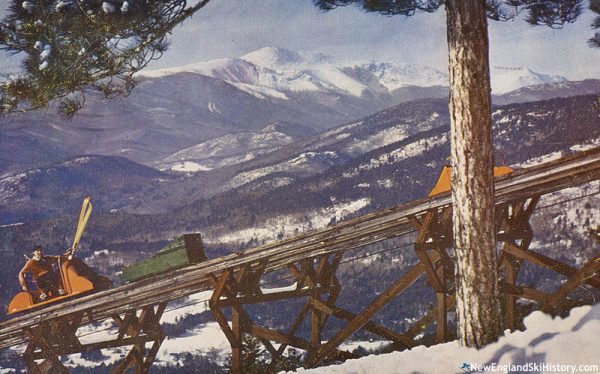
“In the era of rope tows, a cutting edge lift named the Skimobile was constructed for the 1938-39 season. Consisting of a set of cars on a track, it was only the second lift in the state that allowed the skier to be seated while riding up the mountain. Local mechanical guru George Morton was hired to design and construct the lift, which carried passengers halfway up the mountain in about 10 minutes. The New York Times described it by stating, “the device consists of a 3,000-foot board track with a vertical rise which approximates the height of a fifty-story building. Improvised upper mountain lift service for the complex was facilitated via 20-person sleigh pull via a cable attached to a mountaintop power plant.”

The Skimobile proved wildly popular – it looked like a bumper car, but it rode like a coaster – and thousands of skiers rode it every day. Cranmore had a unique, clever, efficient, and modern convenience as its primary transport: How cool! And a rope tow was installed to handle the overflow on busy days. Over the course of the winter, the Skimobile carried 122,000 passengers, more than double Cannon Mountain’s tramway transported that season.
The next logical step was instructors. The solution? Do what everyone else did – bring over famous Europeans. Gibson was particularly enamored with Austrian Hannes Schneider, regarded throughout Europe as first a skiing prodigy, then a pioneering instructor, and finally as the premier teacher in Europe. His Arlberg Method of slow, carving turns transformed ski instruction and turned never-evers into lifers. We still use it to this day.
Schneider was downright legendary, but he also hated the Nazis, outspokenly so…so outspokenly so that when Hitler invaded Austria in 1938 the Third Reich seized Schneider’s school, arrested Hannes, and imprisoned him. It was Gibson who negotiated directly with Heinrich Himmler, the infamous Nazi politician and member of the dreaded S.S. squadron.
Gibson successfully obtained Schneider’s release just a few short months before Germany’s Panzer blitz into Poland, and Scheider was welcomed to North Conway with a massive welcoming party in the town, after which, and NESH.com put it, “Schneider essentially took the reins of Cranmore.” Schneider was elected to the U.S. Ski and Snowboard Hall of Fame in 1958.
CRANMORE THROUGH THE DECADES – ANTI-TRUST AND A WHITE KNIGHT
The history of Cranmore’s fortunes was also followed closely by the local press, who – like always – can make kings rise and fall, and – in a way – may have done so at Cranmore. For example, in the early days of Cranmore, a clearly “homer” press described a newly debuted trail pod – the Rattlesnake Ravine – described it as a likely rejoinder to the infamously intimidating Tuckerman Ravine or the Gulf of Slides.
They clearly overstated the case. Even people from Outer Mongolia know, nothing in New Hampshire is the equal of Tuckerman’s Ravine.
But then in 1968, when larger mountains were developed along the travel arteries of Interstates 89 and 93, business at Cranmore declined sharply. Attitash, Bretton Woods, and Wildcat all had more trails and varied terrain, especially for expert skiers. Further, a January 1968 Portsmouth Herald article lambasted the resort for failing to keep up with nearby mountains Cannon and Gunstock, both of whom were born around the same time as Cranmore, were publicly run, and had outpaced Cranmore in infrastructure and improvements. The ‘70s and early ‘80s also failed to reinvigorate the resort, and Cranmore was sold in 1984 to a conglomerate.
Sadly, the Skimobile suffered a similar fate. After operating on a limited schedule during its 50th anniversary season in 1988-89, Cranmore discontinued the lift at the start of the 1989-90 season. Needing a full eight people to keep it operational was not making financial sense. The lift was removed as the 1990s dawned.
In June of 1995, highly successful developer Les Otten and his LBO Resort Enterprises Corp. purchased Cranmore and promptly addressed one of the most pressing problems – they installed a Doppelmayr high speed detachable quad, that reached 1,123 feet, all the way to the summit. Otten is still one of North America’s most successful developers; he’s had the alchemy to turn snow to gold. (So much so that he also was inducted into the U.S. Ski and Snowboard Hall of Fame, Class of 2023.) But it was here that skiing history intersects with antitrust, and whatever plan Otten had was scuttled.
A merger with S-K-I Ltd. in 1996 resulted in the formation of American Skiing Company and a Justice Department order to sell Cranmore due to antitrust concerns. As such, American Skiing Company sold Cranmore and Waterville Valley to Booth Creek Ski Holdings, Inc. in November of 1996. As the DoJ announced in their own press release:
“The Department said that without the divestiture, American Skiing would have controlled eight of the largest ski resorts serving skiers residing in eastern portions of New England. As originally proposed, the deal would raise prices and eliminate discounts to Maine residents for day skiing trips, and to residents of Maine, eastern Massachusetts, eastern Connecticut and Rhode Island for week-end excursions, the Department said….We can’t allow a merger to lessen competition in the New England ski industry, which is so important to the people of this region. Without these divestitures, this deal would have resulted in fewer discounts to skiers living in Massachusetts, Connecticut, Maine and Rhode Island. With Waterville Valley and Mount Cranmore in independent hands, competition for these skiers will be preserved, without impeding American Skiing’s efforts to make New England slopes more attractive to skiers around the world.”
[Author’s Note: The Irony Alarm is blaring all across North America right about now…]
Cranmore then began a long, slow slog of treading water financially. They tried to diversify into summer ops, but the efforts were half-hearted. Cranmore added lift served mountain biking in 1996 and snow tubing in 1997, to go along with its lighted snowboard halfpipe and terrain park. But it didn’t take off like it could have.
The mountain’s fortunes continued to ebb and flow through the financial tumult of the first decade of the 21st century until 2010 when the Fairbank Group purchased the mountain, adding it to their small, but plucky stable of resorts that also includes Bromley in Vermont and Jiminy Peak in western Massachusetts.
Brian Fairbank, chairman of the Fairbank Group, was inducted into the U.S. Ski and Snowboard Hall of Fame in 2024 not as an athlete – but as an entrepreneur and innovator. Like Les Otten, Fairbank is one of the most decorated thinkers and movers in our sport. In 2005, the National Ski Area Association awarded Fairbank the Sherman Adams Award, their highest honor, for his advances in snowmaking technology and in green energy/sustainability. In 2007, Jiminy Peak, Cranmore’s sister mountain, also owned by Fairbank, installed a 1.5-megawatt wind turbine, and subsequently received a coveted sustainability award. And in 2017 the NSAA gave Fairbank its highest honor, the NSAA Lifetime Achievement Award.
Fairbank’s Midas Touch has continued with Cranmore. With the implementation of a master plan to renovate every single building at Cranmore while also increasing year-round activities, over $25,000,000 was initially invested in new developments, upgraded mountain infrastructure, state-of-the-art snowmaking, and modern lifts. Five million of that initial $25M went straight into summer recreation, including a mountain coaster, a zipline course, an aerial adventure park, and summer tubing.
“Recognizing that North Conway was magic, and that Cranmore had the ability to be supported on a year-round basis through tourism, the goal was to expand in summer and reinvest in winter,” Fairbank explained. “Ben Wilcox had been there for seven or eight years by then, and he knew New Hampshire inside and out. He was so great to work with through the purchase, we kept him there, and he is still there to this day, President and CEO. He proves every day we have the right person in the right location.”
Steadily, the resort’s footprint grew. New family ski programs sprouted, more summer park attractions came on line, and a lift-serviced mountain bike park exploded visitor numbers.
“2019 was when the mountain biking really began to take off, with the construction of more trails and a focus on family mountain biking so kids of all ages can rent gear and get coaching. We even took a chairlift that doesn’t normally run in the summer and ran that,” Fairbank noted.
Cranmore’s current redevelopment plan expands the master plan aggressively, with a $70 million dollar base area that will morph the resort into a progressive four-season destination while introducing a second home community.
“We have several projects going right now including a new 80-room hotel that matches the architectural theme of the rest of the village,” Fairbank stated, rightfully proud. “We also have a new base lodge for the winter tubing park – that has been enormous for us – and we are just finishing a 17-unit condo and the ski patrol headquarters.”
And finally, the new Fairbank Lodge opened at the base of the mountain in December of 2023. The 30,000 square foot facility is home to restaurants and bars, Sport Thoma ski shop, retail shops, and 2-unit condominiums with open floor plans.
MOUNTAIN GAZETTEER

Located at a snowy Lat/Lon of 44° 3? 23? North, 71° 6? 36? West, Cranmore is small and ergonomically designed; you can’t lose anyone there. Three main lifts reach the summit, the Lookout Triple, the Skimobile Express Quad, and the Schneider Triple Chair, the latter being the only one of the three that does not start at the base lodge, but from a lower mountain point well to skier’s left.
“Hurricane Road in winter is the gnarliest part of Cranmore,” quipped one irreverent wag of a skier, still smiling ear-to-ear at the ten inches of fresh pow we got even though it was the last week of March, and he’s right. Everything on the mountain is easier than it reads on the trail map; you are not at Cranmore for gnar or extremes. Even glades rated double black at Cranmore are skiable by the vast majority of advanced skiers, making it a terrific training ground for younger skiers and those seeking to elevate from novice or intermediate levels. Being able to shred the whole map, glades included, is a confidence boost as well, so send it everywhere.
Cranmore has over 170 acres of skiable terrain, with 60 trails and glades served by a total of seven lifts. While you can get to anywhere on the map from the one central summit, Cranmore’s map can be divided into three easy parts: The Schneider pod, the mountain’s center section, and the intermediate pod of trails to skier’s right.
The vertical drop of 1,400 vertical feet is the equal of nearby Gunstock Mountain, and Cranmore’s summit elevation of 2000 feet and base lodge elevation of 600 feet are nearly identical, (Gunstock’s summit elevation is 2,200 and its base lodge sits at 800), but the similarities end there. Cranmore has fewer steeps, but more glades.
The lift lines are wide and welcoming, though they feature runbling reverse camber in some sections. Hurricane, Middle, and Koessler are the three runs spoken of the highly by expert skiers. Some New England purists, however, prefer the trails cut more narrowly through the woods with interesting twists and chicanes. North Conway, Arlberg, and Skimeister are your quintessential New England tight, curvy trails that snake through the forest, and they offer most excellent views of Mt. Washington.
Finally, the glades run a wide gamut of varied width and are peppered liberally throughout the map. A quartet of short but tight Gibson Chutes are a tribute to the founder. Little more than just short, narrow, steeps only one turn wide, it’s best to straight line them.
Snow is plentiful all winter long, and the resort boasts state-of-the-art snowmaking with wall-to-wall coverage across the trail map.
NORTH CONWAY, NEW HAMPSHIRE, A TRULY GREAT SKI TOWN
It happened again. For the fourth time. Readers of USA Today voted North Conway, New Hampshire the Number 1 ski town in America. It’s now won the award in 2016, 2017, 2020, and 2024.
“North Conway absolutely is one of the greatest ski towns in America. It is a retail Mecca and am outdoor Mecca,” beamed Fairbank energetically, also quick to point out the USA Today piece in our interview. “The New England Ski History Museum is there. The village has 40-50 restaurants. Six or eight new hotels were built within the last 10 years. There is hiking, kayaking, rafting in the summer, and Mount Washington is a beacon of outdoor activity and adventure.”
Some of you may scoff at USA Today readers, but the sentiment was echoed by the Boston Globe in numerous Boston.com articles. North Conway may not have the glitz and glam of Salt Lake or Whistler., but folks coming to North Conway aren’t there for the party scene. You don’t come to North Conway to do club drugs with Norwegian models in slopeside hot tubs; you come to North Conway to do battle with both the mountain and the elements. And in winter in the white Mountains, the skiing is primal. Likely the most ferocious winds in the contiguous 48 states, always among the bitterest temperatures in the lower 48, and perennially vying for most snowfall in the country, what the White Mountains lack in altitude, they more than make up for in weather. So, buckle your helmet, and show Ullr and everyone else what you’ve got, because you’re in for a helluva ride. That’s why you come to North Conway.
And sure enough, though 2024-25 was feast, then famine in the Northeast, th4e White Mountains came through again. As March progressed an early thaw looked to scuttle any hopes of a spring season. But Ullr fooled us, thankfully, and as we rolled into North Conway, clouds blew in behind us. Flurries followed, back-to-back storms that dropped ropes and re-opened trails thought to be closed for the season.
And for two glorious pow days the stoke rekindled into a roaring fire. Such is the magic of the White Mountains. Such is the allure of a wild day of eastern skiing. The stoke is wherever you bring it with you.
[Editor’s Note: This is the fourteenth article in our series analyzing the battle between Vermont and New Hampshire ski resorts. As the series progresses, here are the places we’ll visit:
For New Hampshire: Attitash, The Balsams, Bretton Woods, Cannon, Cranmore, Dartmouth, Gunstock, Loon, Pat’s Peak, Sunapee, Waterville Valley, Whaleback, Wildcat
For Vermont: Jay Peak, Bolton Valley, Middlebury, Killington, Mad River Glen, Magic Mountain, Mt. Snow, Okemo, Smuggler’s Notch, Stowe, Stratton, Sugarbush/Sugarbush North, Bromley
Other articles in this series:
PART 1 – WATERVILLE VALLEY
PART 2 – MAGIC MOUNTAIN
PART 3 – SMUGGLERS’ NOTCH
PART 4 – ATTITASH
PART 5 – MOUNT SNOW
PART 6 – CANNON MOUNTAIN
PART 7 – STRATTON MOUNTAIN
PART 8 – MOUNT SUNAPEE
PART 9 – LOON MOUNTAIN
PART 10 – JAY PEAK
PART 11 – PATS PEAK
PART 12 – GUNSTOCK MOUNTAIN
PART 13 – SUGARBUSH
PART 15 – BOLTON VALLEY
PART 16 – MIDDLEBURY SNOWBOWL