


[Editor’s Note: We’re back with another installment of Jay’s Insider Guides, this time from the mighty mountains of Utah. Our subject this column is a pretty public course tucked sleepily in the foothills outside Salt Lake. Say “Hey!” for the little publics that overachieve. They are the true life blood of then game.]
OGDEN, UT – It was one of the most surreal moments in my journalism career – the interview subject turned the tables on me.
“Jay, I’m curious,’ began Matt Bain, head superintendent of the two courses and 27 combined holes of golf in the town of Ogden, just north of Salt Lake City. “I looked you up, and you’ve played famous courses all over the world. What made you choose Mt. Ogden Golf Course?”
At first blush, you might think he was right. Here’s a tiny municipal course run on a shoestring budget built on the side of a mountain. It’s only 6,300 yards from the tips. It’s not known for any particular golf architectural pedigree. It might even have a hole or two some people would call zany. Why then is it found on the same list of my assignments this season that includes fabled courses from the northwest of England (including Open Championship venues) and the private enclaves of Long Island?
The answer is that while I didn’t choose Mt. Ogden at first – I covered last week’s U.S. Ski and Snowboard Hall of Fame Tournament there – I certainly choose to come back. And that’s the greatest compliment I can pay a golf course.
Mt. Ogden charmed me with its vibe, its affordability and accessibility. Sure, it’s not National Golf Links of America. But golf is a big tent, and Mt. Ogden has something for all players – a course everyone can enjoy, from expert to beginner. Most importantly, it’s a fun round in a gorgeous setting that won’t take five hours, break the bank, or cost you half a dozen golf balls. And as a little muni course led by a smart team of do-gooders and go-getters, it’s a course we can all support most enthusiastically.
Why did I choose to return to Mt. Ogden, Matt? Because Mt. Ogden won me over.
THE DIRECTOR AND THE SUPER

Success starts with a team with a vision, and between super Matt Bain and PGA Head Director of Golf Todd Brenkman the goal of providing a premiere public golf experience at an affordable price has become reality. Both men are locals – born and bred in Ogden. And both are golf lifers.
“I got into golf in high school, and ended up working at Mt. Ogden under my mentor and father figure, Jeff McFarland,” begins Bain, who has come full circle, returning home after sojourning to Nevada. “I tried college and was actually a psych major at Weber State, but I met my lovely wife Veronica there, and when she ended up getting a job in her home town of Reno, I followed her.”
Still, Bain loved golf, and realizing he could make a career out of the sport, he worked on the grounds crew of two Reno courses, Andrea Golf Club and Wolf Run. And then in 2010, after cutting his teeth for two years, Bain aimed for the stars and grabbed one: he applied to, was accepted by, and matriculated to the prestigious school of turfgrass management at Rutgers University: if not the best program in the country, then top two or three for absolute certain.
And what a time to be there: studying under both golf architect Stephen Kay and turfgrass master scientist Richard Hurley! That’s like studying guitar under Eric Clapton and David Gilmour.
“Those were heady years. Stephen Kay is a wonderful, kindly, intelligent, funny, and generous man,” Bain recalls, chuckling, recalling the designer of Architect’s Club and the restoration architect and venerable Forsgate Country Club’s Banks Course. “And Richard Hurley has done everything in the field of turfgrasses. He’s the cutting edge. I couldn’t be happier with the education I got there.”
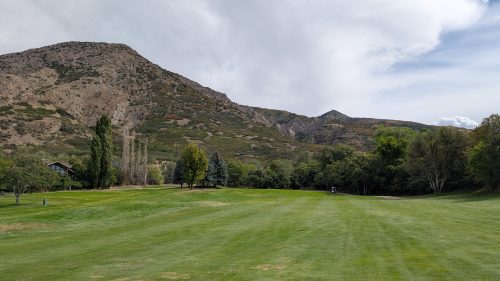
Bain put that education to good use, and hiring him in 2012 as part of the grounds crew for both the 18-hole Mt. Ogden course and the 9-hole course also owned and operated by the town paid instant dividends. Conditions at Mt. Ogden are pristine. On a limited, tiny town budget, Mt. Ogden plays as smoothly and cleanly as any country club. You don’t need a million-dollar budget to maintain a terrific golf course. You just need a smart, motivated grounds crew that can creatively prevent problems from happening and quickly solve them when they do.
“It was three years ago when Jeff retired that I was promoted to Head Greenskeeper,” Bain recalls fondly.
The proof of the pudding is in the tasting, and even though Mt Ogden sees 40,000 rounds of golf a year, the playing surface is nonetheless as good as anything in Utah, and that includes private or resort courses with much larger maintenance budgets. Indeed, Mt. Ogden scores a nine out of ten in the conditioning category of a rater’s notes. And once they start mowing the ends of the fairways so that they blend more seamlessly into the entrance of the greens, they’ll earn that 10th point.
“We use the majority of our budget on fertilizer and chemicals. We also just renovated all 18 holes with a brand new irrigation system; that was a game changer. We were fixing an average of 40-60 leaks in the PVC pipes a year. And now our new system is firing on all systems,” Bain confided. “And this recent fall weather and rain were magic for the conditions.
“And when it comes to set up,” added Brenkman, “we always try to keep the higher handicapper in mind – even 18-20 handicappers.”
ON THE COURSE, THE INSIDER’S GUIDE TO MT. OGDEN
From an architectural standpoint, Mt. Ogden will prove one of the toughest “short” golf courses you’ll ever play.
“That’s because of all the elevation changes,” offers Brenkman. “It definitely plays one of the longest 6,300-yard courses anywhere. People also make the course harder than it really is by trying to hit driver all day long cutting corners trying to drive greens.”
“Yes, and there is a huge difference between how a pro analyzes this golf course compared to an amateur. If you want to get aggressive and go really low and you try to drive every par-4 green and hit every par-5 green in two, or that you can or you can play safe and hit 6-irons everywhere and keep your ball in play. Thinking you can go low and executing the shots every time are two different things.”
And that is one crucial key to Mt. Ogden – brains, not brawn are the key to solving the puzzles of this cleverly designed golf course.
“Make good decisions,” concludes Brenkman. “That’s the secret to scoring low at Mt. Ogden.”
On that note, there is one other indisputable truth at Mt. Ogden – straightest ball wins! Regardless of ability, your tee shots must land in the fairway. The course is not as challenging or penal as people can make it out to be. Mt. Ogden might offer you a rope to hang yourself, but you don’t have to take it. So don’t try to cut the corners at short 90-degree doglegs at, for example, 15 and 16, because that’s the way to turn three or four into six or seven.
The course plays to an symmetrical par of 37-35=72 with three par-5s on the front (all appearing between holes four and seven). Both loops of nine begin by ascending steeply uphill for the first four or five holes, and then turn and descend gently back down towards the clubhouse.
“Pretty much everything has a dog-leg, even the snack bar and the ladies’ grill,” observed one irreverent wag of a player.
“I’ve played this golf course 10,000 times in my life,” and I think it can play 10,001 different ways,” Bain states firmly. That may be, but there is a rhythm to the golf course as well. Start by scoring early as holes one through three are “what you see is what you get,” – no tricks just reasonably tough par, but easy bogey. But it’s GAME ON from the fourth tee on.
The stretch of four through seven – par-5, par-3, par-5, par-5 – is the sturdy backbone of the golf course. It’s a springboard for expert golfers to go low, but it’s survival tine for short-hitting amateurs. Back-to-back par-5s, when designed well, are a wondrous rarity in golf. Courses such as Fabled Forsgate Country Club and venerable Royal Lytham and St. Annes are sterling examples of All-world back-to-back par-5s. They are best presented with one long and one short, as they are here at Mt. Ogden’s sixth and seventh.
“I love six, but it gives a lot of people heartburn,” quips Brenkman. “And seven used to be a par-4 until just a few years ago, until we changed it.”
“Yeah, if you hit driver in a bad spot on six, you bring in a a big number,” warns Bain. “I’ve seen great golfers take a 10 on that hole.”
While this stretch could throw scary numbers at careless golfers, take heart, because relief is on the way. Holes eight through 12 are all green light specials for everyone.” Once again, the 90-degree dog-legs are replaced by more Christian hole shapes with strategic options.
The 13th is a bit of a standalone at Mt. Ogden, requiring the longest, straightest drive of the day followed by the longest, straightest second shot. Easily the hardest hole on the inward nine and potentially the hardest over all, penal hazards can swallow balls on both sides of the steeply ascending fairway.
14-18 are all quirky, short, and pretty. Trying to drove the green at 15 and 16 may not be worth the risk when positional golf can similarly yield birdies. In fact 15 green slides sharply away from the player, but that’s what a proper golf architect is supposed to do: they’ll let you have a chance to hit a green in one shot less than regulation, but they certainly don’t have to help you do it.
Mt. Ogden is exactly what golf needs more of: shorter, more affordable courses with an eye on architecture and minimalism that every golfer has access to – both beggar and king. Mt Ogden isn’t the proverbial “Little Engine That Could,” they are the “Little Engine that Does.” They succeed at their imprimatur while staying in their lane; they are at the vanguard of what a public golf course should strive for in the 21st century.
Why did I come here in the first place? The Ski and Snowboard Hall of Fame picked it. Why do I return? Because these guys are killing it.