

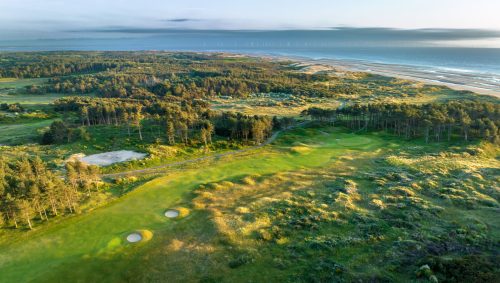
FORMBY, LANCASHIRE, ENGLAND – Sojourning to England’s fabled Golf Coast to play true links golf on fast, firm, sandy soil is a reverie from which you never want to wake. The waves of the Irish Sea lap lazily to shore, shaggy, sun-dappled dunes bound endlessly along the edges of slender fairways that twist between and among them, and fickle winds blow this way, then that way, sending errant shots to perdition.
Best of all, as you look around you at the setting, you would have no inkling whatsoever of what year it is.
Back in the heady, halcyon days of a nascent English golf scene, golf courses were built along railway stops. Now a sesquicentennial later, the rail line is still the easiest way to explore one of Planet Earth’s great golf locations. Eight seaside links in all – three Open venues and five others that have hosted every other tournament worthy of note – eight seaside links near the cities of Liverpool and Manchester comprise England’s Golf Coast. Five of them are consecutive stops on the Merseyside rail line: Royal Birkdale->Hillside->Southport and Ainsdale->West Lancashire->Formby (Freshfields stop). And Royal Birkdale, Royal Liverpool, and Wallasey are all just a stone’s throw away. These are all, singular golf experiences that stay with you forever. When you visit an ancient, storied English links, you step back in time to a more civilized age.
With over 140 years of golf history, Formby Golf Club, exceeds even the most seasoned golfer’s highest expectations. A trip here is all your wildest golf dreams come true – pageantry, beauty, architectural brilliance, and incomparable history. Formby Golf Club delivers them with all splendidly, especially the history.
While Formby has never hosted the Open Championship, it has hosted nearly every other major amateur and professional golf tournament of note – the Amateur Championship four times, the English Amateur Championship five times, – only the Open and the Ryder Cup are beyond Formby, and only because there would be nowhere for 60,000 patrons a day and a city of tents and stalls. But some of Formby’s history has echoed through the centuries without the necessity of trophies.
Let’s start with Maurice (pronounced “Morris”) Flitcroft – a folk hero to the everyman golfer forever known as the “Phantom of the Open.” Flitcroft never won a tournament, never cashed a check as a professional golfer, and you’ll never inscribed his name on any coveted trophy, but Flitcroft’s story couldn’t have been written better by Central Casting. He was a chain-smoking, weirdly-coiffed crane operator from Barrow-on-Furness, a blue collar worker from the industrial northwest who, battling with several mid-life crises at once, fell in love with golf after watching the Open championship highlights on the telly.
No Dr. Frankenstein ever created a monster faster.
Flitcroft was instantly obsessed, though he had never swing a club in his life, he suddenly felt…KNEW!…that this was his calling, his dream, his apotheosis.
So he began practicing, if you could call it that, to qualify at Formby for the 1976 Open Championship, at nearby Royal Birkdale, just five short train stops away on the Mersey Rail. No professional teacher, no golfing buddies, no club membership anywhere and with zero holes of competitive golf actually played – not so much as a Sunday Nassau for a shilling a hole – Flitcroft set off the tilt mightily against the windmill. He’d sneak on to private clubs in the middle of the night, “practicing” until dawn brought the maintenance team to unceremoniously chase him off.
The DIY aspect of the entire project was both hilarious and endearing. Mismatched clubs, no proper golf shoes, only a glimmer of knowledge of some of the rules of golf, the oblivious beginner Flitcroft was blithely walking into qualification for the de facto World Championship of golf.
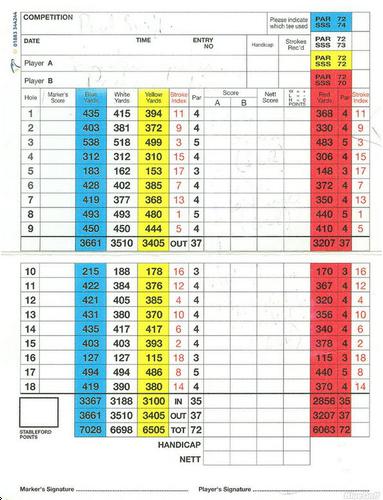
Listing himself as an unattached professional he carded a ghastly 61-60=121* The asterisk, actually written on the scorecard by player Jim Howard, one of two unfortunate playing partners, whose scores suffered mightily from Flitcroft’s ineptitude. Worst still, he held up the entire tournament looking for his errant shots.
He was so awful and so clueless about everything to do with golf, let alone professional golf, that he R&A banned him from ever entering the Open again.
Yet that was the beginning of Shakespearean-in-magnitude drama and Machiavellian skullduggery on both sides! It pitted golf’s newest, cleverest and most loveable knight errant, the middle-aged crane operator from Barrow-on-Furness versus the storied, venerable Royal and Ancient, because Flitcroft refused to take getting banned lying down. He began entering and re-entering Open qualifying for the next seven years under preposterous fake names and playing while wearing ludicrous disguises. He tormented R&A officials by repeatedly finding almost Vaudevillian ways around the increasingly desperate attempts of the R&A to catch his entries in time to stop him from playing, including handwriting experts.
Flitcroft gave the R&A shingles trying to catch him, while the rank-and-file UK golfer cheered his antics with ever-increasing amusement and support. The fake names included such atrocities as “Gene Paychecki,” “Arnold Palmerston,” “Beau Jolley,” “Gerald Hoppy from France” and – in an instance where his niece postmarked the entry for Switzerland to fool the R&A yet again, a Swiss baron who spoke no English.
Flitcroft would get a few holes into another ghastly qualifying round – once paired with the immortal Seve Ballesteros, who won three Opens – someone at the R&A would comment to officials, “We better get out there. We have another Flitcroft on our hands…” and when the cart would pull up someone would see through the disguise and shout, “IT IS FLITCROFT! GET HIM!” and he’d be removed by the nearest bobbies while the fans roared with delight.
Flitcroft’s story became a film not long ago, “the Phantom of the Open,” an imperative addition to golf’s contribution to the silver screen. And in 1988, the membership at Blythefield Country Club, in Grand Rapids, Mich., flew Flitcroft and his family in for its now annual “Maurice Gerald Flitcroft Member-Guest Tournament.” Worst score wins.
Then there is old Horus the Hippo. [Insert Jay’s bilious British accent]. Back in the Late 1880s, Edgar Storey, 1896 captain of the links, shot a hippopotamus in North Africa. He stuffed his head, named him “Horus” after the Egyptian god of light, and mounted the head in his home.

His wife, however, loathed it as an affront to her living room, and when Edgar died in 1909, one of the first things Mrs. Storey did was…err…graciously donate…Horus to Formby Golf Club. Or as graciously as “Get rid of that of that thing” can be effectuated.
Cut to 1941, and it’s World War II, the Battle of Britain and all the northwest courses were taken over by armed forces, often the Royal Navy. They were given the run of the various clubs. Freshfield Golf Club, for instance, was once requisitioned by the RAF, and the Luftwaft have maps claiming to bomb the whole area.
As it happened, one night three naval officers drinking in the Formby clubhouse got over-refreshed and thought it would be funny if they took the hippo and brought it back to their ship as a prank.
So, they did. And no sooner did they get aboard with their prize when the signal went out from High Command that their destroyer was putting out immediately into the North Sea and the Battle of the Norvik to go hunt U-boats. Find them, they did, and with Horus strapped to the light tower for luck. Horus did his part, as the ship survived being hit twice by torpedoes. Horus took a bullet in the teeth, but that was easily mended and the victorious ship returned to port.
Of course, word about the popular, but purloined “lucky hippo mascot” had gotten back to some stuffy admiral who knew exactly what Horus was and where he truly belonged, and upon the ship’s docking informed the perpetrators they would be court marshaled. Happily, the Captain of the links interceded on the poor defendant officers’ behalf and all ended well with a simple letter of apology and Horus’s triumphant return to the club as a decorated war hero.
In the bar room adjacent to Horus’s corner of the clubhouse, an owl sits stuffed and mounted on the wall also.
“He’s hung in the members’ bar since 1914. The poor thing was hit with the gutta percha ball we mounted in the case along with him,” explained club historian Ian Jamson. “Years ago one club officer didn’t like it and tried to hide it in a broom closet. He said it didn’t fit the décor. But I found where he had been spirited away ,and so I reframed him and put him back up.
Lastly, the gorgeous, stately clubhouse, opened in 1901 after the previous clubhouse burned down, is one of three great area clubhouses designed by Charles Hutchinson. The others are Royal Lytham and Royal Liverpool, and all three feature ornate rounded turrets and balconies.
“The first clubhouse was just a little hut where we sold whisky for three pence,” Jamson recalled.

For a 25th anniversary present to the club, in 1909 Bruce Ismay gave Formby Golf Club its prominent clock mounted on one turret. Ismay, you recall, was the owner of the white Star Line of ocean liners, including the Titanic, which Ismay escaped by skulking into a lifeboat full of women and children.
“Yes, unfortunately, he survived,” groused one member, who shall remain nameless.
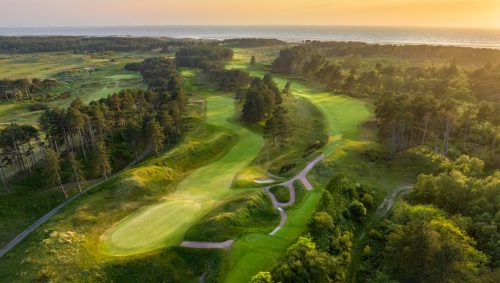
On the course, Formby is a smashing, scintillating links. With three distinct ecosystems – linksland, mature, conifer-covered holes, and rolling heathland. And although the club doesn’t have the ‘Royal’ title like its three neighboring clubs, it is certainly one of the prize jewels in England’s Northwest Golf Coast crown. But best of all, when you travel to the northwest of England to play links golf, you step back in time 150 odd years. To keep it that way has been British golf’s dearest dream for all that time. To our inestimable delight, Formby has succeeded.