

Praying at the Cathedral of the Andes, Argentina’s Cerro Catedral
[Author’s Note: As a continuation of our 20th anniversary celebrations, could there be a more atmospheric venue to write about than Argentina’s mighty Cerro Catedral? Not bloody likely…so here’s my review of the mountain as it appears in 2025, along with travel tips…]
VILLA CATEDRAL, RIO NEGRO, ARGENTINA – Bob Dylan once sang, “We’ll be on edges soon, said I…proud with heated brow,” and it was with wide-eyed wonder that I gazed upon the Andes Mountains, the roof of the Southern Hemisphere, thinking myself off the map for certain.
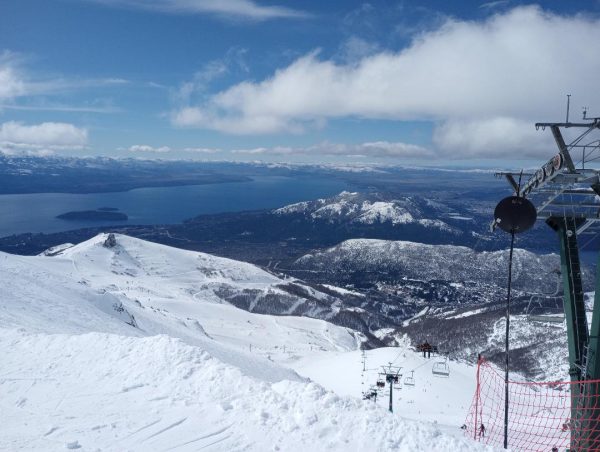
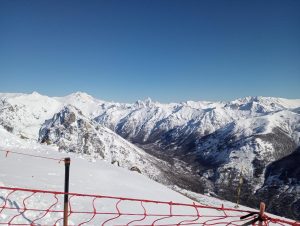
With all the irrepressible hope of a Jorge Luis Borges protagonist, I tasted my first tang in the air of a Southern Hemisphere winter, a symbol of rescue from a New York summer’s oppressiveness while Andean condors, the second-largest flying birds on Earth, soared effortlessly overhead. On one side a vast ocean of snow-capped peaks stretched endlessly while crystalline Lake Nahuel Huapi – the Island of the Jaguars in Mapuche language – shimmered below, gleaming with the fiery heart of a diamond. Turning around, like the spires of a Tuscan church reaching skyward towards Heaven, so too did the ancient granite rock formations pepper mighty and majestic Cerro Catedral’s brow, offering line after scintillating line beneath and between them: chutes and narrows, steeps and moguls tumbling precipitously from the 7,800-foot ridgeline.
And though I’d traveled nearly a full 90 degrees latitude from my home – half a world away – I found the same incontrovertible truth that I find everywhere: the joy of skiing unites us all, regardless of country, continent or hemisphere.
CATEDRAL ALTO PATAGONIA
I was told before I left America that Catedral Alto Patagonia, (or just Catedral), the largest, and most venerable ski resort in South America might be, perhaps, the most drop-dead gorgeous summit lakeview in our sport. One prominent magazine even gushed “The most beautiful ski views in Earth?” In my recent Skiing History Article, Viva Catedral! A Short History of Skiing in Bariloche, (July/August 2024), colorful Argentinian Olympian Oswaldo Ancinas full-throatedly roared a resounding “Yes!”
Even he may have understated the case. It’s the skiing of your dreams come to life.
But Catedral is far more than just a Sistine Chapel of skiing and snowboarding. It is also the grande dame of South American winter sports, boasting close to a century of rich history. That article traced the heady, halcyon origins of skiing in the region and the colorful characters that came to define Argentinian skiing for a century: blonde, skinny Hans Nobl, muscular Antonio Lynch, graceful Catalina Reynal, (“La Madrina” – the Godmother of Patagonian skiing), and Olympic and international athletes Ruben Macaya, Oswaldo Ancinas, Roberto Taddeo, and Vicente Ojeda. And being immersed in their living history, with the echoes of Olympics and World championships past being recalled by the athletes who lived it, was joyful.
Macaya, for example, between skiing and coaching in Argentina and the USA never saw a summer in 35 years. Or Ancinas, who was so affable during his appearance at the 1964 Olympics at Innsbruck, they gave him a gold medal for being the most personable and entertaining athlete in the Olympic Village. Their adventures, struggles, and triumphs were more than just inspiring sports stories. They laid far more than a foundation for the colossal cultural footprint that is Argentinian winter sports. They lived their lives the Argentinian way – with a joyous la dolce vita. It’s like what Kurt Vonnegut wrote about the difference between doing things in style versus doing things with style. The former makes yourself look good, while the matter makes you and everyone around you look good. That’s the Argentinians: spreading love and good cheer at every turn. If only everyone were like them, this would be a merrier world.
That too is the ethos of Catedral – la dolce vita taken to the nth degree. Argentina is a feast for the eyes, the stomach and the soul and Bariloche, the ski town 11 miles from Catedral encapsulates the best of Argentinian cuisine – wine, pampas beef and lamb, and chocolates the Swiss would envy. And the Argentinian people are rightfully renowned among the most festive and welcoming people on the planet.
“You must come to ski Soldier with me and we’ll cook Argentinian steaks!” beams an ebullient Macaya.
“No!” bellows an equally gregarious Ancinas. “You must come to Tahoe and ski and cook steaks from the pampas with me!”
You do both, of course, because the invitations are worth diamonds.
Argentina is a sumptuous banquet: a banquet for the eyes, the stomach, and the soul. A trip here is a broader cultural mandate, an absolute imperative. But its people are its deepest and most valuable treasures. Typical of skiing, I went to shred, and fell in love with the country. You go to Argentina, you come back with 20 new lifelong friends. That’s the magic of the stoke.
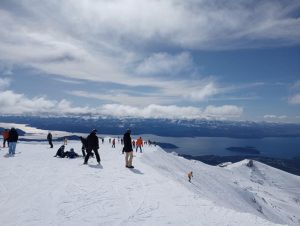
But a trip to Catedral is also an exercise in perspective…staggering, gobsmacking perspective. Upon gazing out from the summit ridge, atop everything around you except the condors, you see yourself on a planetary scale amidst the vast ocean of mountains extending across the horizon. On a clear day, Patagonia’s incomparable variegated grandeur blossoms before you – lush, verdant evergreen and deciduous forests that have thrived for millennia tucked amidst the sapphire alpine lakes dotting islands in the sweeping majesty of Lake Nahuel Huapi. Even Chile’s distant volcanos loom ominously on the horizon. They still occasionally erupt.
We all feel the ineffable joy of skiing. That’s what the stoke really is: that feeling of inner peace when the entire world and all its traffic and tribulations are reduced the next mogul or turn or scan of the terrain. Nothing exists except being present in the moment the thrill of our emotions in full ascension.
Now imagine that stoke in Argentina, the Andes, a veritable edge of the planet. It’s a simple formula: stoke + wanderlust = bucket list. And whole worlds open up inside you as well.
MOUNTAIN GAZETTEER
As the years passed, Catedral prospered and progressed, remaining all the while at the forefront of the Southern Hemisphere winter sports industry. Regular upgrades occur at sector part of their footprint, from trails and package offerings to lifts, lodgings, food, and sundries. In 1957 the first South American Ski Championship was hosted at Cerro Catedral. An in 2017 Catedral held its first World Cup event.
Today, the total vertical drop at Catedral is a whopping 3,379 feet; that’s twice that of Mount Tremblant. On the mountain 29 lifts can take over 33,000 people uphill per hour. That’s roughly the same number of fans that can fit in Boston’s Fenway Park for a baseball game.
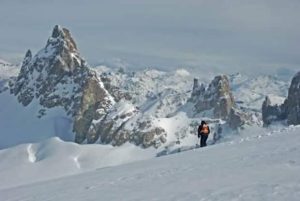
Best off all, at Catedral’s sun-drenched summit, the vertical cathedral spires are paradise, with dozens of pitched routes, chutes, and steeps in between them. Lap 1,000 feet at a time at a sustained 35 degree pitch all day to your heart’s content. And then there’s the backcountry. While Catedral boasts a whopping 1,500 skiable acres in bounds, millions and millions more acres of untouched, virgin Andes powder lay just adjacent in the easily accessed side and backcountry. Vast expanses of the Andes National Park are just a few minutes bootpack through a notch at the summit.
Much is made of the fine, dry Andean powder you’ll find on the summit at depths of up to 20 feet, and zooming through the drifts while cascading through the minarets of stone, but the snow does get heavier and wetter as you descend to the lower slopes. Loss of snow late in the season used to be a problem on the lower slopes until recently; new snowmaking has alleviated any further “running the gauntlet” – i.e. trying to find snow on the more popular ways to get to the base area at the end of the day.
One of the best times to plan your trip is the final week of August as the Santa Rosa, a fierce spring storm, arrives in Argentina five days before or after the namesake saint’s festival on August 30. That’s also the time when high school seniors, enjoying one last break skiing, descend upon any ski area they can find before returning to start their final year of school. Slopes can get a bit harried then.
“At times it reminds me of the Kansas run at Sunday River on a late Saturday afternoon…a Chinese Fire Drill!” quipped one irreverent wag of a skier, and he’s right. There is no semblance of order on any South American slopes. English speakers, don’t expect anyone to understand “ON YOUR RIGHT!” let alone react correctly. Lift lines are at best confused, with people just funneling. Oddly, although a chairlift might fit four, but the entry to the lift might only fit three, adding to the confusion boarding. But hey, it’s Argentina. Just go with it. It’s called “the A Factor” – embrace it, because there is no getting around it. Everything moves slower south of the border.
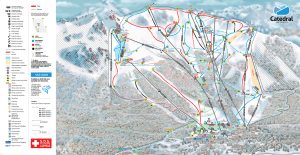
The 55 named and mapped trails cover a vast 75 miles of terrain. “Pista Panorámica” is, to most, the most iconic run on the mountain. Rated as intermediate it starts at the summit and descends over 1,000 feet along the western edge of Catedral.
“Honoring its name, which means ‘panoramic view’, on sunny days as you slide down the slope you can spot the peaks of many different mountains such as Cerro Tronador, Cerro Puntiagudo (Chile), Cerro Negro, Cerro López, Cerro Bella Vista, among others,” stated Belen Jonssen, PR maven for the resort. “You can appreciate the Lago Nahuel Huapi’s immensity, Bariloche City and Lago Gutiérrez’ waters along with Cerro Ventana,” she concluded proudly, and rightfully so. ‘El Filo’ is another favorite slope of visitors to Catedral. Given its location that runs through the entire Catedral summit, this trail has a privileged view of the ski center, the lakes and the imposing Cordillera de Los Andes.”
“Piedra de Condors was my favorite, but in my day we had to walk up there,” adds Ruben Macaya. I won the giant slalom there in 1960. My start number was 45,” he recalls with the laser clarity of a master historian.
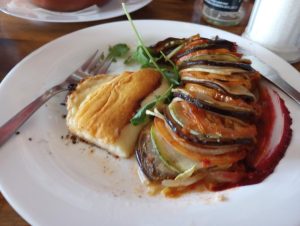
“Nubes” is the expert chair, and Your Author’s favorite trail pod, with lines and chutes peppered around the summit and throughout the granite outcroppings. The area is kept mostly ungroomed so moguls and choopy snow are the primary challenge. Two upper mountain chalets, called Refugios high on the ridge, Refugio Lynch and Refugio Punta Nevada. Both have restaurants, though Lynch serves more upscale dishes like Beef Bourgignon and Veal Milanese. In fact, nearly all the food options destroy the USA’s heat lamp pizza and greasy cheese sticks. It’s real food versus junk food, and you can feel the difference when you ski/board.
As of this writing, Catedral has over eight lodges distributed at the mountain’s key points, offering all services, a diverse culinary selection, and spectacular views. The three in a row off the top – Lynch, Punta Nevada, and Barrilote, are the most opulent and roomy.
“The huts in the system were built with volunteer immigrant labor—nails and shingles carried one box at a time up the summer trails,” adds quintessential Argentinian winter sports icon Vicente Ojeda, another in the long and unbroken line of stellar athletes-turned-guardian of the country’s sacred sporting history. Vicente won the 1952 South American Downhill and was taught as a grommet by Catalina Reynal herself.
“The base of Catedral offers a wide range of services and activities for those who visit it: ski schools for all ages, levels, and styles, 7,000 sets of ski equipment, 1,500 snowboards, as well as cross-country ski equipment. There are over 7,000 beds on site, dozens of bars, cybercafés, pubs, typical restaurants, and international cuisine,” Jonssen noted. “There is also a highly specialized private medical center with a first aid center, nursing room, X-ray services, and ambulance services.”
But that’s just the beginning. There is also a gargantuan, two-level on-site mall, with one of the largest Burton stores in the world as its centerpiece, as well as pharmacies, churro stands, even hairdressers. The base area doesn’t just feel like a resort, but its own small city that never sleeps. Information and customer service teams and tourist information centers provide services throughout and beyond the resort, including adventures into the greater province of Rio Negro.
While there are plenty of ATMs at Catedral, changing money in Argentina is an adventure. Throughout Argentina there are places you can informally exchange either US dollars or Euros for Argentinan Pesos, but there are far fewer ATMs in Argentinian towns. In tourist locations the exchange rate is often worse than the ‘blue rate’ published on various web sites, simply because the demand for pesos are higher in those areas. Moreover, there often is a wide gap between the “Blue Peso” rate – an unofficial and black market rate – and the official rate listed by the government when changing money. Since most businesses places take credit cards, you should get the “Tourist Rate,” which closely tracks the blue rate, so use credit cards where you can and you should be fine.
International ski traffic at both Catedral and in Argentina in general increased sharply after an overnight devaluation of the Argentinean peso in 2002, which suddenly made a world-class ski destination four times more affordable. The American dollar is so monumentally strong against the Argentinian Peso, (which until recently was in free fall), that on our trip, a big, thick, juicy Argentinian ribeye steak cost $8.00 U.S. It was $11.00 if you wanted salad and mushrooms. We converted at a rate of one dollar to eight hundred pesos, but as we go to press, the American dollar now is worth 1,070 pesos. At that rate American tourist troops have been known to clean out whole banks in small towns.
That good news goes double for lift tickets. Day passes run about a fraction of lift tickets as Utah or Colorado resorts, at least half or more on most occasions. We skied four days for an average of $40 per day. Ages 70 and up ski free!!
GETTING THERE AND ODDS AND ENDS
Flights depart regularly from Buenos Aires for Bariloche on Aerolíneas Argentinas. International travelers, however, should be aware that many flights originate in Buenos Aires’s domestic airport (Jorge Newbery Airport), which is around one hour away from the international airport (Ezeiza International Airport). Those traveling from abroad to should be sure to schedule sufficient time to make this transfer in Buenos Aires.
Remember that in Bariloche and Catedral you are one hour ahead of EST. So when it’s 8 in NYC it’s 9 in Bariloche.
In Bariloche, the Carlos V hotel is quite comfortable and completely civilized. They were playing Talking Heads’ Stop Making Sense when I checked in. Uncanny: It was almost as if they were waiting for me.
Do they have almost exclusively stick shift rental cars in Bariloche??!! Maybe. And you will need chains. And that’s a PAIN IN THE ASS! SO take taxis or a tour. Saveur the Journey is the Gold Standard when it comes to combining skiing and culinary adventure. www,saveurthejourney.com.
THE WISDOM
It’s 4:00, and the base lodge scene is a wondrous cacophony of sights and sounds and smells: Churro stands are wafting cinnamon and caramel. Steaks are char grilling with a mouth-watering savoriness. Pretty girls in highlighter-colored outfits chat us up about soccer…excuse me…futbol over dolce de leche at an outdoor café.
Like skiing, soccer is the international language and my, “Thank you for beating France and Mbappe in the World Cup,” made me everyone’s new friend.
“No, thank you for getting Messi to play in your country,” gushed one suddenly starry-eyed young lady enjoying her customary senior year trip. “Messi in a pink jersey! All my dreams came true!”
But all humor aside, I return to the aforementioned Borges, who in his seminal short story “The South,” called Patagonia, “an ancient and far more ancient and sterner world.”
More ancient, yes. Majestically so. But sterner? Forgive me for not suppressing my irrepressible hope because I am a skier. And like Borges’s cat who lives eternally in the instant of the present, so too for a skier does time fade, the only meter being the next turn of the skis and the next scan of the terrain. Yes, like Borges’s protagonist, when you travel south you also travel into the past, but one truth is timeless. No matter how big the world is, how tall the mountains are, how small we are individually, together we are so much more. And that is the la dolce vita of Catedral and its people.
STATISTICS
Quality of Snow/Grooming – 9.25
Variety of Terrain – 10
Lifts – 9.5.
Snow coverage – 9
Natural Setting – 10
Kid/Family Friendly – 9.25
Character – 10
Challenge – 9.5
Dining on Mountain/Base Lodge – 9.5
Value – 10
Overall – 9.60