

[Author’s Note: This story also appears at Golf Course Trades Magazine]
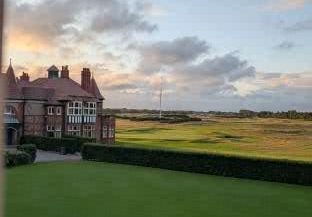
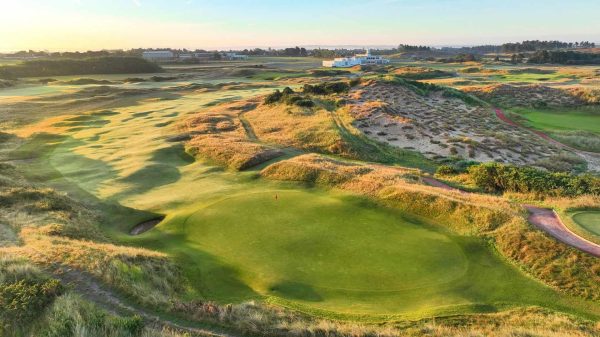
SOUTHPORT, MERSEYSIDE, ENGLAND – The Open Championship – the de facto world championship of golf – returns this summer to the northwest coast of England, a cradle of the game and home to eight of the most venerable and challenging links on the planet. Three of those clubs – Royal Birkdale, Royal Lytham & St, Anne’s, and Royal Liverpool – have hosted the open close to a combined three dozen times. The other five – Wallasey, Hillside, S and A (Southport and Ainsdale), West Lancashire, and Formby – have all hosted a galaxy of other professional and amateur championships, including the Ryder Cup and the venerable Amateur Championship. With many of these courses on each other’s doorstep and the others a short train ride away, you can step back in time to a far more civilized age of golf for the trip of a lifetime. And with the right kind of eyes, you’ll think you also stepped back in time 100 years.
THE ROYALS
When they say “Royal” in England they mean it. In order to earn the coveted distinction, the club must be patronized, then nominated by royalty; Kings, Dukes, Earls, they all count. There are a mere 66 Royal clubs around the world, from Australia to Canada and back again, and each and every one of them must be impeccable to earn and maintain that coveted title.
I choose that word with precision: impeccable. Perfection only, nothing less. King Charles himself and three of his most fuss-budgety friends – say…Imelda Marcos, Gordon Ramsay, and the crown prince/sultan of [insert name of obscure Indian Osean island] they must be able to enter unannounced (not that they would) and find not so much as an ort, thread, weed, or speck of dust can be out of place. Better still, when you visit you eat off the finest china. You sample the latest in haute cuisine. And your every whim is catered to with white glove service. You’ll think they mistook you for being royals.
ROYAL BIRKDALE
Dazzling Southport, the decadent Vincent Hotel, shimmering waves lapping at white sandy shores, all the Beatles music you can ask for, and for the 11th time in history the Open Championship this summer: that’s what Royal Birkdale holds in store for the golf world come July.
Birkdale is perhaps the most beloved of all Open venues by the fans as sight lines are fantastic throughout the course; patrons walk and stand atop the hurly burly dunes that surround the fairways. Birkdale also enjoys a welcome combination of decent weather, knowledgeable golf fans, lively side diversions in Liverpool, easily accessible beaches and good roads in and out.

The golf course has always had a Jekyll-Hyde reputation where you go low on the front nine, but hang on for dear life on the back, similar to Royal Lytham, just a few miles north. And like Lytham, recent architectural changes have tried to even out the two sides, but the more things change, the more they stay the same. It will take at least one more Open to have enough numerical data and a broader analysis sample to see how the changes are affecting scoring.
Still, two things remain true at Birkdale: 1) the almost 90-degree, right-angle dog-leg, par-4 first hole is still one of the toughest opening holes in major championship golf; and 2) you better birdie the short par-5 17th coming down the stretch on Saturday and Sunday if you want to win the Claret Jug.
Jordan Spieth won the Claret Jug nine years ago when we last saw Birkdale. That Open became immortal after Spieth “recovered” for a brilliant bogey at 13 from the practice grounds – calling up shades of Seve Ballesteros at Lytham in 1979. Then Spieth went 5-under over the next four holes to zoom past a stunned Matt Kuchar, who played the same stretch 2-under, but found himself out of contention by the 18th tee.
ROYAL LIVERPOOL
Ancient and storied, now renovated and resurrected, Hoylake, as the course is called by its friends, took a 39-year hiatus between Roberto DiVicenzo’s victory in 1967 and Tiger Woods’s triumph in 2006. But the moniker “The Once and Future King” rings true as a career arc for the golf course’s major championship history.
Switching literary metaphors (to a man in the same writing circle) Getting everyone there and back again was the main issue that kept the R&A away for Royal Liverpool for four decades. Open attendance was mushrooming wildly in the ‘60s and ‘70s and the tiny roads in and out of Hoylake weren’t capable of handling upwards of 50,000 fans a day, but new roads and a successful restoration of the golf course have sent Hoylake soaring back up the top 100 lists world-wide.
Major championship wins by Tiger Woods and Rory McIlroy will do that for a course’s profile. Sorry, Brian Harmon, but you? Not so much…
Not as difficult as either Lytham or Birkdale, the course’s main defenses are pot bunkers everywhere, a cunning routing that features internal out of bounds in dangerous spots, and new internal green contours. When the wind kicks off the river, the course’s fangs sharpen considerably. Your Author’s favorite holes come in the middle of the round as you meander along the linksland in the shadow of the mourning hills of Wales standing in lonely eminence across the Mersey. You most certainly never want to return to the real world. One of my playing partners that day inquired about purchasing a house across the street. Just a cozy two million…pounds, not dollars…

ROYAL LYTHAM & St. ANNE’S
Lytham belongs in the Pantheon of Earth’s Greatest Golf Courses for two inimitable features: 1) its unique and inspired routing and 2) the hardest bunkering in the world.
Those are not overstatements. I dare you to go and find out for yourself. I double dare you.
I triple dog dare you. Go play Royal Lytham and report back to me. We’ll see what remains of you after Lytham’s shredding is over.
Seriously though, you’ll have fun walking in history with every bloodcurdling step. 167 bunkers – ONE HUNDRED AND SIXTY-SEVEN BUNKERS – down from 207 the last time they held the Open there in 2012! Remember that Open? Adam Scott fell out of the sky to leave a Claret Jug on the ground for a surprised but grateful Ernie Els to waltz home with. That same year, Tiger Woods took three to get out of a bunker at number six. Now everyone gets to try that shot.
As for routing, the course opens with a par-3, and closes with six consecutive par-4s. With three par-3s and back to back par-5s in the first nine holes, like Birkdale, you score on the front, and then survive the murderous finish. We hope to see Lytham host the Open soon. It’s ready. The modifications by Marti Ebert and his team have been completed and the renovated holes – the par-5s at six and 11 – look and play brilliantly.
THE REST OF THE NORTHWEST COAST
FORMBY
Anyone who limits their golf in the northwest to just the Open venues is making a gargantuan mistake. You cannot fully understand either the history or the architecture of Golden Age golf and links golf without visiting them and paying homage.
Chief among them is scintillating Formby, a stunning links comprised of three distinct ecosystems – rugged linksland, wild coastal dunes, and fragrant, wooded pine forest. Each contributes to a unique character that plays even better than its immeasurable beauty. Willie Park Jr. established the main 18-hole course layout in 1912, and later improvements were made by Harry Colt and Donald Steel.
It also has some of the most notable history of any club anywhere. After fire destroyed the original clubhouse in 1899, the new clubhouse was topped with iconic clocktower by industrialist Bruce Ismay, owner if the White Star Line who as some critics say “unfortunately survived the sinking of the Titanic.” Formby is also where the legend of one Maurice Flitcroft was born, better known as “The Phantom of the Open.”

Flitcroft was an everyman dreamer who fell in love with golf watching the telly, and then tried qualifying for the 1976 Open Championship as an “unattached professional.” It went worse than expected. Of course, his score of 121 was a record of futility that still stands to this day, but between Flitcroft’s prickly demeanor that day and the distraction he proved to his playing partners, the R&A banned him from competing in the future.
This led to golf’s greatest cat and mouse game, whereby Flitcroft would enter Open qualifying under fake names and wearing disguises, and the R&A would employ handwriting experts to fetter out Maurice’s applications before he could take the first tee. Several times a disguised Flitcfroft was escorted off the course to the delight of fans who delighted in his antics. On one occasion he was paired with a teenage Seve Ballesteros and wished the kid, “Have a good cojones…”
WEST LANCASHIRE
Windswept and wild with storms rolling in off the water unpredictably, West Lancs as it is lovingly called is everyone’s favorite practice ground. A blustering crosswind serves as the prevail, placing a premium on both length and distance off the tee. A galaxy of links bunker styles – from deep narrow trenches to pot bunkers as deep and narrow as barrels – surround insidiously contoured greens. And the club is one of the oldest in the world, founded in 1875. Indeed, West Lancs was the first among the eight great northwest clubs predating even Royal Lytham and Hoylake – and is one of the ten oldest clubs in England.
The modern links was designed in the late 1950s and ‘60’s by C.K. Cotton as two loops of nine that were a conglomerate of the previously existing Men’s 18-hole course and Ladies’ 9-hole course. Two other architects have played important roles in West Lancs’s history: Fred Hawtree advised the club on critical landfilling work in the 1970s, preserving and protecting the precious sand dunes while also building them up higher. Then Donald Steel came in to improve everything from greenside defenses to bunkering to internal green contours. In an interesting quirk of routing, every par-5 on the course is followed by a par-3.
Precision and perseverance are the necessary attributes to survive the maelstroms that buffet you for 18 holes. Even putts are severely affected by not only the wind, but the ruthless false fronts, sides and swales of West Lancs’ gorgeous greens. Remember: Brave heart! Nae wind, nae golf!
HILLSIDE
Founded in 1911 and directly adjacent to Royal Birkdale, Hillside is renowned throughout is a premier championship links known for its dramatic,, dune-lined back nine, often described as a “hidden gem” adjacent to Royal Birkdale. Extensively redesigned by Fred Hawtree in the 1960s, it offers a distinct contrast between its flatter front nine and a spectacular, elevated back nine, regularly hosting major tournaments like the 2019 British Masters and the 2024
SOUTHPORT AND AINSDALE
For those of you disillusioned with how the Ryder Cup has devolved to brutish tribalism, I present Southport and Ainsdale for your consideration. Like a reverie that materializes from the mists of time, the course meanders through heaving seaside dunes, abuts charming neighborhood, and traverses across and over terrain at times wild and unruly and at others idyllic and pastoral.

The par-5s are Your Author’s favorites at S and A, all of them presenting fascinating strategic problems in an unforgettable natural setting. The second runs as straight as a ramrod through a peppering of pot bunkers sprinkled liberally from tee to green. The seventh features a dramatic tee shot over the corner of a massive bunker to reach the fairway beyond. And the All-World 16th features a second shot that must carry one of the deepest and most treacherous bunkers on the planet to have a chance to reach the green in regulation. Huge numbers await should you fail.
The club hosted two Ryder cups from the Golden Age – 1933 and 1937. The latter was the first time a visiting team defeated the hosts. Founded in 1906, the course was significantly redesigned by James Braid in 1924.
“You won’t find James Braid’s work anywhere in the States. Sea sickness made certain of that. But at S and A you can still see how masterfully Braid weaved his way through the natural flow of dunes and sand hills and why he ranked so highly among all those Golden Age architects. S and A alone is worth the trip.”
WALLASEY
Could Wallasey be the prettiest of all the great Northwest links? It sure makes a compelling argument. Nowhere are the dunes as Brobdingnagian! Nowhere did German artillery shells leave larger craters in the neighboring rough! Nowhere are the fairways more tumultuous! Wallasey is Shakespearean in magnitude when it comes to dramatic terrain for golf. Standing on the fourth tee box with the edge of the Irish Sea beckoning for a sliced golf ball, and nothing but sea and sky and the mournful mountains of Wales in the background, a player has gone to golf Heaven without having to die to get there.
Elevation changes challenge you on every hole. Fascinating green complexes require careful forethought from the fairway or even the tee box.
Founded in 1891 by members from nearby Hoylake, Old Tom Morris of St. Andrews, four times Open champion, laid out the first links. Course improvements were made in 1901 by Alex ‘Sandy’ Herd (Open Champion 1902) and in 1913 by Harold Hilton (four times Amateur Champion and twice Open Champion). In 1936, a new lease meant that the acreage was reduced and a new layout was required, so Martin Hawtree joined with J H Taylor, with additional advice from James Braid.
Wallasey is also proudly the “Home of Stableford” as member Dr. Frank Stableford perfected his wacky scdoring system there, presumably because he incessantly opened rounds with terrible first holes.
Come for the history and stay for the beauty. Or is that the other way round? Either way works: the skyline green of number 10, the 12th holes, tony and prim as a cameo, and the church tower standing in lonely eminence over the course.
One day Bobby Jones started a fire there when he climbed to the top of the church tower, lit a ciggy, then dropped the still-burning embers into grass below. Genius!
[Author’s Note: We will visit several of these clubs in the coming columns.]
TRIP TIPS
If you can, avoid Alaska Air and Aer Lingus. It was total hell the last time I flew to England. Lost golf clubs, a layover hotel with no air conditioning or dinner for the stranded flyers, and “Cocaine Bear” for the in-flight movie. Well, that or “Dungeons and Dragons 2: Honor Among Thieves.” And playing golf with someone else’s clubs is as much fun as kissing your girlfriend with someone else’s lips.
DO NOT EXPECT MEDIUM RARE BEEF! ANYWHERE!
BONUS POINT
For all you culture vultures out there “The Once and Future King” was written by C.S. Lewis, while “There and Back Again” was hobbit Bilbo Baggins’s diary in J.R.R. Tolkien’s “Lord of the Rings” series of tales. Both of them were members of a writing circle known as the Inklings.