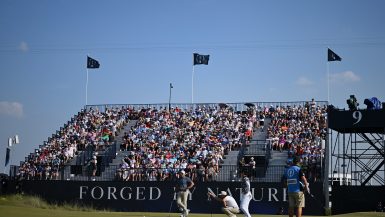



SOUTHPORT, MERSEYSIDE, ENGLAND – Like a dream from which you never want to wake, a walk amidst the heaving dunes and rumpled fairways of Royal Birkdale is a golfer’s greatest wish come to life. The sting of the salty
spray in your nostrils, the wild, whirling winds whipping the flag, and the fairways winding through the mighty dunes like pathways through a maze: a round at Royal Birkdale is absolutely celestial, a transportive and transformative experience.
This year, Birkdale will mesmerize as it always does, but it will also feature long sought-after changes. For decades the book on Birkdale was “go low on the front nine, then hang on for dear life on the back nine.” That’s because the prevail at Birkdale is with the players for the outward nine and in their face coming home. Additionally, it seemed that players hit the same or similar clubs on all of the par-3 holes. Now with the guidance of seminal architect Tom Mackenzie, Birkdale may have made those adaptations, and this could be the best iteration of the course to date.
“The major difference from last time is that the fifth hole has been completely overhauled. Tinkered with regularly over the years, it was always the ugly sister of the course. The members recognized that. They decided they wanted a short par-4 where the golfers would be tempted to have a go, but have lay-ups as well,” Mackenzie explained energetically. “At just over 300 yards, it’s perfect. Depending on the wind, it’s a three-wood for the long hitters, a driver for everyone else. We raised the green by four feet, so the bunkers play much deeper than before. There is also a better habitat for the Natterjack toads.”
Natterjacks, incidentally, are best known for their bold yellow stripe down the back and a secretion that tastes terrible and causes nausea if ingested. Kind of like LIV Golf, but I digress.
Two of Birkdale’s par-3s also feature significant changes The seventh has been – Surprise! – shortened, from 180 yards to 150. However, the green, like the fifth, has been raised, this time by three feet. Once again, the bunkers play much deeper than before. The hole now plays into a left to right wind from a high tee to a high green, a difficult shot to judge with a lofted club. Much like Augusta National’s 12th or the 11th at Shinnecock Hills, shorter is often sexier. Further adding to the difficulty of the renovated front nine, the par-4 sixth will play a whopping 514 yards. A sharp dog-leg with no corner to cut, driving accuracy will be an imperative here.
On the homeward nine, the 14th and 15th holes are both new, and par has changed on both.
“We wanted to diversify the wind direction and club selection on the par-3, so we looked for a new place to put the par-3,” Mackenzie begins, explaining with a true magister’s touch. “So, we dropped out the old 14th and made the old 15th become the new 14th. Now that’s a par-5.”
It can stretch to a whopping 602 yards. Bunkers dangerously pinch the left side of the fairway on both the drive and any lay-up. The deep green sits at an awkward angle to the fairway, making even pitch shots a nervy test of distance control.
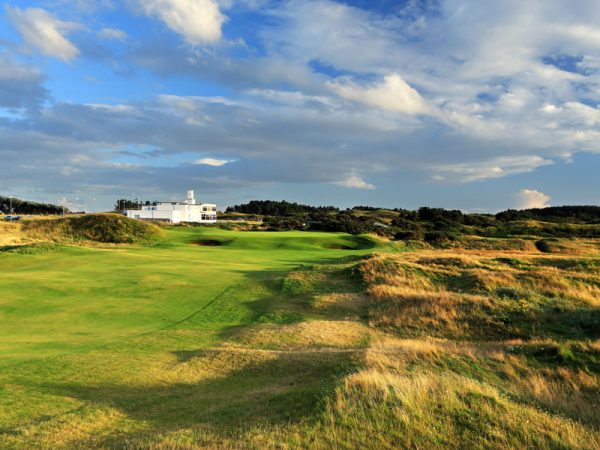
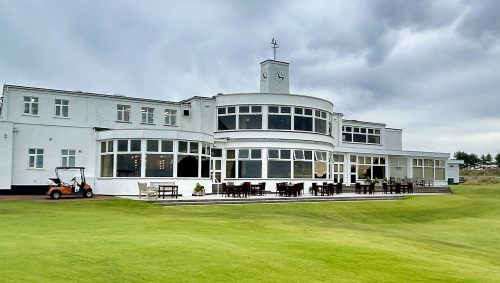
Realizing they had room for the new hole now, they moved the second half of the 14th fairway a few feet to the side, moved the 16th tee box to the side of a nearby dune, and – Presto! – the new par-3 fits perfectly, playing towards the art deco clubhouse as the backdrop as a bonus. Brilliant, right?
“Not quite, Jay,” Mackenzie interjected, part morosely and part laughing. “They put a big hospitality tent there for this week.”
Oh, well. Womp womp.
Part of the par-3 rebalancing exercise, the 15th plays much longer now, a beefy 241 yards, but it is also downwind. Better still, the front of the putting surface is open, so fans of true links golf may see several players playing one bounce and on, especially those not from the U.S.
“We intended that,” confirmed Mackenzie. “That’s a good choice.”
Jordan Spieth, the defending champion from the last time the Open was held here – 2017 – expressed caution about the hole’s difficulty in a non-prevailing wind direction.
“I think that 15 can be a great hole with the right tee box and pin with the right wind direction. I thought the old 14th was a fantastic par-3. I think this course has some of the best par-3s that we play in any Open Championship. I think the back tee with this east wind at 3-wood, it doesn’t make a whole lot of sense with the way the green is, but it’s also not supposed to be that wind direction,” he noted.
“So I think hitting somewhere between a 4-iron that can stop — like we played the up tee today, and it was 201, but it’s in your face and you’re hitting 220-yard 4-irons. You still have to hit a nice shot, but if you do, you get rewarded. It’s a really cool designed hole, but it needs to be played at the right yardage. Otherwise, it can get pretty funky.”
While the changes to the 14th and 15th are the most obvious amendments to the back nine, Your Author’s eye was also on a fascinating new cross hazard at the par-4 11th. The previous bunkering forced to many players to lay up short, but now players that drive too far and don’t have just enough draw can run out into the hazard and a likely stroke lost.
Of course, all eyes will be on the 13th after the Shakespearean-in-magnitude drama Jordan Spieth authored in 2017. One of the finest shots in Open history, his cannon of a 3-wood from downtown Blackpool snatched victory from the jaws of defeat and triggered a 5-under in four-hole stretch to zoom past poor Matt Kuchar like he was waiting for the rail line. At a brawny 502 yards and with the cavernous dunes slavering, it will be the one hole every golfer can’t wait to tip-toe past without harm.
As for places for spectators to get the best view of the play, Mackenzie imparted a few of his favorites.
“The fifth is great spectacle – a short par 4 is always dramatic,” he noted. “Then I’d say on the long dune between the 14th and 15th holes. Watch players hitting shots in to the par-5, and you’ll see shots on both 15 and 16 as well.”
Mackenzie worked on the project with Senior Design Associate Mike Howard, who has been a member since he was a junior golfer. Mackenzie and partner Martin Ebert have been designing and redesigning golf courses since 1989, first with Donald Steel & Company and then, from 2005, as Mackenzie & Ebert Ltd. Mackenzie & Ebert currently advise all 10 of the 10 current Open Championship venues, as well as such legendary clubs as Royal Dornoch in Scotland, Royal Porthcawl in Wales, Royal County Down in Northern Ireland, and Portmarnock and The Island in Ireland.