

Southport and Ainsdale – Ancient and Venerable, Rare and Wonderful
—Special to JF.com and Golf News Net—
[Editor’s Note: Last year our Indomitable Sportsman, Jay Flemma, spent a glorious eight days lost amidst the fabulous dunes of northwest England – England’s Golf Coast as it is called. As we turn towards GNN’s live coverage of the 2026 Open Championship at Royal Birkdale, Jay will have stories from Birkdale and beyond. In this installment, Jay sings the praises of two-time Ryder Cup venue Southport and Ainsdale, at times pastoral and idyllic, at times wild and hurly-burly, but at all times charming.]
SOUTHPORT, ENGLAND – Hometown talent and homegrown hero Tommy Fleetwood – successful and famous enough to select any club he desires to join for the rest of his life - chose to become a member of S&A.
Not Birkdale. Not Formby Golf Club, Not Hoylake. Not Royal Lytham. Southport and Ainsdale. Is that enough of a recommendation for you?
On the short chance that it’s not, my word will have to do. Ancient and storied, rustic without being anachronistic, and as sterling an architectural pedigree and history as any course on the planet, S&A, as it’s known to its friends, is as regal as a club can be without actually having the “Royal” designation. It certainly has entertained golf royalty for close on a century.
Any discussion of S&A starts with the early days of the Ryder Cup. Not the overhyped, overpriced, machismo-laced golf fistfight that Madison Avenue and corporate bean counters have turned that once hallowed event into, (and like we saw in greater NYC last fall). No, we’re talking the heady, halcyon, formative years of a nascent scene, a more elegant tournament from a more enlightened age.
I know I sound like Obi Wan talking about light sabers when I say that, but it’s true, and it’s funny because it’s true.
Samuel Ryder had a vision even before Augusta National: to show the world that golf is not just a shining example, but the gold standard of sportsmanship. S&A had already shown its quality as a top venue as the host of the Dunlop Professional tournaments earlier. Now its international reputation would skyrocket even higher into the stratosphere.

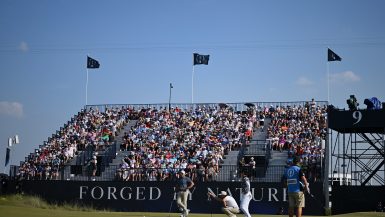
Yes, the event was fiercely competitive; even back in the 1930s each team wanted to beat the snot out of each other for national pride. And yes, there was gamesmanship. But the Americans’ victory – over what was then the team from Great Britain and Ireland – the Americans’ victory was the first time a visiting team won the cup on enemy soil, a breakthrough for the event. The USA won five more Ryder Cups in succession. According to Hank Gola, it was the 1937 Ryder Cup at Southport that tipped the balance of golf power in favor of the American side.
“The return match in 1937 would tilt the competitive balance for decades. A second generation of American golfers, born just before Francis Ouimet struck the first blow for his country, would go on to claim Ryder Cup after Ryder Cup. Ralph Guldahl, Byron Nelson and Ben Hogan were Texas-born, Sam Snead in the hills near Hot Springs, Virginia. Each of these future American golf legends came into the world between November of 1911 and August of 1912, and all but Hogan, who would certainly play his part later, made their Ryder Cup debut in 1937 when they were twenty-five years old. Combined, they would win seven of the next thirteen US Opens, eight of the next fifteen Masters and seven of the next fourteen PGA Championships. It was obvious that Great Britain wasn’t producing young golfers of that caliber. The introduction of steel shafts allowed for the modern, grooved swing that the younger American players mastered. Theirs was more of a power game than the ‘feel’ game of the British,” Gola wrote.
The rise of the professional tour in America helped tremendously; the tour the galvanized the American players into professional golfers. The British were exposed as golfing professionals. British papers, predicting pre-tournament that the Americans were lambs to the slaughter quickly ran subsequent headlines reading “LAMBS BITE BUTCHERS.” Astonishingly, the American side didn’t even need Walter Hagen, who admitted that by them he had succumbed to “Whiskey Fingers,” as Hagen called it.
Strictly as an aside, “whiskey fingers,” huh? So, what do we call his fingers that…lost…the first Wanamaker Cup…in that cab…in St. Louis? Cue the Rolling Stones, perhaps?
It was depth that proved the winning edge at Southport – that and the Americans were better prepared for the English weather than their opponents. Gola noted that the PGA had provided the American team with rain suits and towels. The Brits, in their more cumbersome gear, carried only umbrellas for protection—and they weren’t holding up very well.
Home team as they were, the the GBI squad should have darn well known better. You can get all four seasons at Southport in a single morning or afternoon round, but no matter what weather you get, you’ll be sad as you play your final approach to 18 because it means the conclusion of one of your most unforgettable golf adventures.
Of course, the club is a museum of Ryder Cup pageantry with relics from the Golden Age of the tournament encased in glass in every corner. And certainly, the stately, refined membership are the crème de la crème of English society in all their incomparable charm. But more than anything at S&A it is the tang of the salt air in your nostrils, the quiet of the charming neighborhood holes, the hurly-burly, wild fairways as you approach the sea – mountainous at times – that stay with you forever. S&A draws you with its mystique and aura. It remains with you because of its inimitable charm and vibrance.
ON THE GOLF COURSE
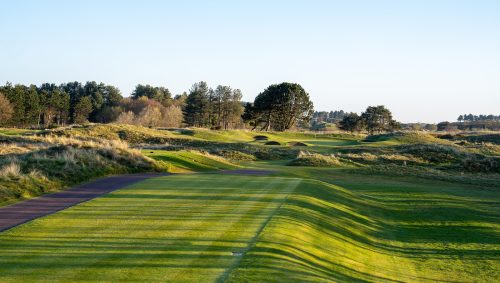
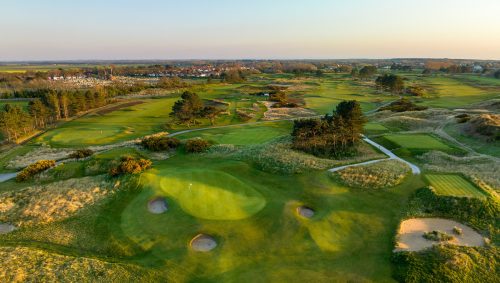
The course you find today was originally laid out in 1923 by James Braid. True linksland in that it links the village to the seas through a series of increasingly larger sand dunes, S&A sits in the middle of the stretch of linksland that stretches from Blundellsands to Southport.
The routing makes cunning use of the dunes as holes not only wind like a serpent between them, but also thrillingly traverse across and over them. Some tee shots thread between the saddle of the ridges while others must carry over a diagonal hazard to reach the fairway. Blind and semi-blind shots are delightfully commonplace.
“It’s a heartfelt place for me. I played on the Cambridge University second team. I shot 100 in the trials, but then shot 76 in the fog. I also got to play against Oxford,” recalls quintessential British architect Martin Ebert, who during his illustrious career performed some renovation work here. “It’s a beautiful course blending several different features – heathland, heather, pine trees, dunes, and even the railway line. Braid worked pure magic here. It’s absolutely a must-play for all visitors to the northwest coast.”
Just like its illustrious neighbor to the north, Royal Lytham and St. Anne’s, S&A opens with a par-3, a devilish one strikingly similar to Lytham’s in its Redan-like set up and length. Unfortunately for the golfer, there is significantly more rough and shaggy undulation at the opener here. Anything but a perfect long iron, hybrid, or fairway is begging for a par and bogey is not guaranteed either.
“It’s a beautiful green nestled in the dunes,” Ebert noted fondly. “And at over 200 yards, the hole gives you a little of everything you’ll see at S&A. It’s a great start.”
Next comes the long, straightaway par-5 second, with its fairway ringed with no less than 13 deep pot bunkers. It’s reminiscent of the second hole at West Lancashire, also a straightaway par-5 between massive towers of dunes, but at West Lancs the bunkers reachable off the tee are center-line.
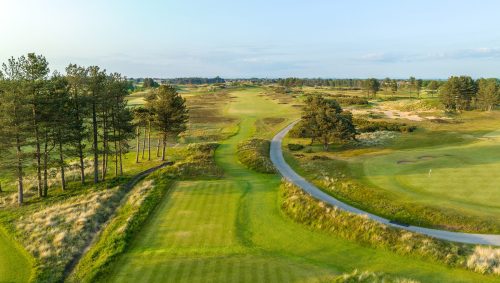
Indeed, all the par-5s at S&A are phenomenal, the centerpieces of the golf course, and the sturdy backbone of the out-and-back routing. At the seventh, you are presented with one of the most thrilling tee shots of the day, a driver over the diagonally placed mound in front of you. The fairway bends left and continues, pinched at the edges by treacherously deep fairway bunkers. Five more bunkers frame the front right and left. A third par-5 appears at the ninth hole, and so the par at Southport and Ainsdale is an asymmetric 37-35-72.
The final par-5, the 16th, the world-famous “Gumbley’s,” totals 500 long, tumultuous, stupendous, and unforgettable yards. Your eyes do not deceive you, and no, your playing partners are not pranking you. The hole plays along the railroad tracks, tumbling over the sandhills, until it reaches a massive hillock with a cavernous, wooden-planked sinkhole of a bunker at its foot. Your second shot plays blind over that bunker to a green about 130 yards in the distance. It’s one of the most thrilling (and frightening) golf shots you will play in your entire life. But you can also card the most astronomical number you ever posted too. If you get stuck in that bunker, you might get to China before you get out. Cue Jules Verne, anyone?
Americans journeying there may ask how or why any golf architect would have even thought to route the hole over that monstrous hillock, let alone construct a bunker at its feet, but Golden Age architects were not shrinking violets, and particularly not Braid. His other designs include Gleneagles, Carnoustie, and Royal Troon. So those seeking to test their mettle, get their money’s worth from Braid. The puckish Scotsman must have been licking his chops waiting for opening day and the moment he could spring this most excellent prank on everyone. On one day during the 1937 Ryder Cup the great Henry Cotton hit into the Brobdingnagian bunker. He lost the hole and the match.
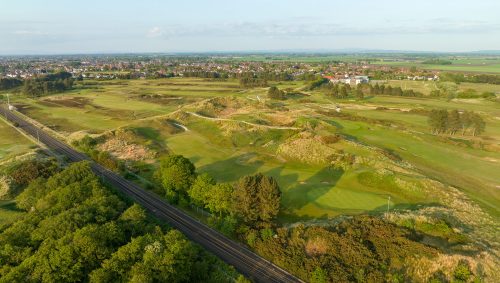
Though many pundits and players sing the praises of the inward nine – and it is nothing short of sublime – Your Author prefers the front, especially the stretch of dunesland holes from two through seven. You want to get lost in those opening holes and never return to the real world; Southport and Ainsdale is a true panacea and elixir of a golf course, a charming embrace and delightful excitement all at once. You came here to play amidst the dunes. Now you are joyfully in their welcoming embrace.
My only quibble with the design comes at the severely uphill par-3 eighth, which feels modern and connective when compared to the natural flow of the other 17 holes. Severely uphill par-3s are difficult to execute, however there is ample room at the back of the green to accept less-lofted clubs. Still, it’s the only hole that looks like it could be anywhere.
“The finish is a run of fascinating holes,” adds Ebert. “14 features wonderful links topography, and 15 is a really good short par-4 with its angled green. You have to watch the bunkers on the left side, miss the target, and you’re struggling to get up and down.”
Of course, Ebert also sang the praises of the incomparable 16th, as well as the 17th, with its fairway strewn with bunkers and gnarly rough along its entire left side, and its green perilously close to an out-of-bounds railway fence. But it was the 18th that may be Ebert’s second-favorite hole on the course, (after Gumbley’s).
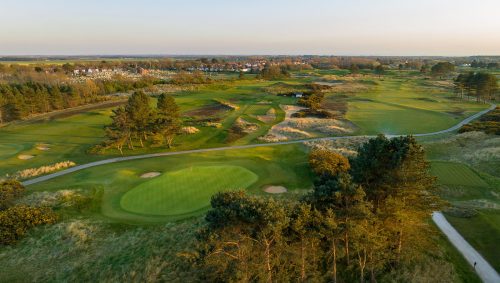
“What a finish! Emerging from the dunes, no one can escape the watchful eye of the members with that green nestled beneath the clubhouse. It’s a short four, but it calls for two excellent shots to end the day,” he observed. “A great opener and a great closer, it’s tops and tails at Southport,” he chirped brightly.
Tops and tails, eh? I’m going to go with tops – as in tops of the planet. Southport and Ainsdale is an imperative. Its incomparable history, its gorgeous natural setting, and its welcoming members all belong in the Pantheon of the world’s greatest clubs. Both a museum and a paean to the game’s glory days, Southport and Ainsdale may be the most underrated course simply because it has so many superlatives, you run out of time celebrating them.
NEWS, NOTES AND QUOTES
Hank Gola on the U.S. team’s ship ride to England, “Laverne Guldahl [Ralph’s wife] had told reporters her husband feared winning the U.S. Open and making the Cup squad because of his seasickness. Although Nelson said it was smooth sailing, Snead said he got queasy, an opportunity the veterans seized on to haze him. According to his autobiography, they told Snead the cure was celery stalks and hard rolls and no other food, plus two hours of dancing nightly in the ballroom. He complied, ‘and darned if it didn’t work,’ he marveled.
When you visit, be sure to meet Charlotte Pilkington. She’s not only a wonderful asset to the club, she has won 13 of the last 15 Women’s Club Championships, including seven in a row, then six more consecutive.