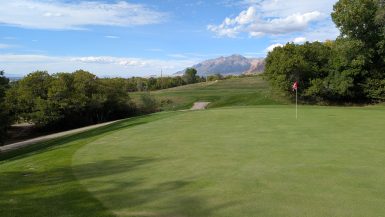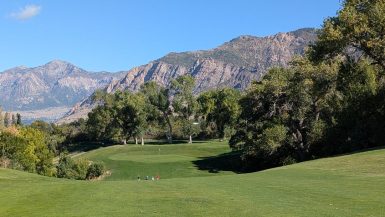


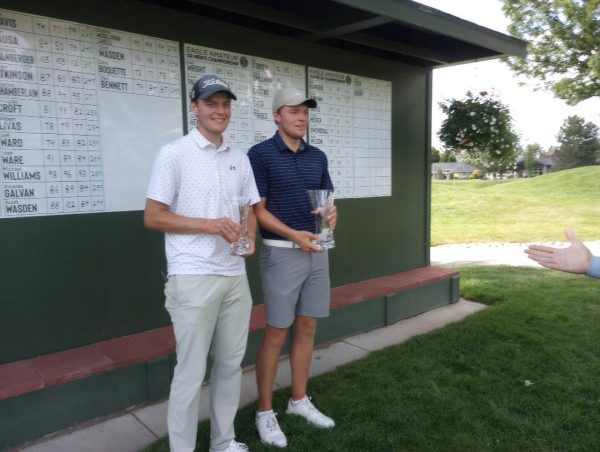

EAGLE, ID – Twin phenom golfers Brad and Ben Mulder channeled Venus and Serena Williams as they finished first and second respectively in the 2025 Eagle Amateur Golf Championship at Idaho’s BanBury Golf Club. Brad defeated his brother by two strokes over the blustery 6,908-yard John Harbottle design that, while ordinarily welcoming and friendly for weekend golfers, turned ferocious when lengthened and sharpened for tournament play. Mulder’s final round 74 featured penalty strokes on holes 16 and 18, but no other competitors could mount a charge late after he squandered a four shot lead early, then rallied mid-round. He finished the three day tournament at a 4-under par 209 aggregate.
“It was a pillow fight out there, none of us played well,” Brad Mulder admitted candidly. “I got a lot of mileage out of my 65 yesterday,” he concluded, referring to the 6-under masterpiece he carved the day prior that gave him a leg up starting on Sunday. BanBury plays to an asymmetric par of 35-36=71; there are three par-3s on the outward nine.
Mulder begin the day with a three-shot lead over his brother, but over the front nine Ben seized the lead.
“It was difficult going from 4-up at one point to 1-down, but I woke myself up after a pep talk.”
Still a college student, Mulder has to remember: four shots is one bad swing and one bad decision, and at the amateur level that happens faster than you can say, “missed the cut.” You’re going to lose leads, the question is “Whether you fold or not?” and the only answer to that question is “NO, YOU DON’T”.
Brad did what all great athletes do in the clutch, he grinded it out. He knew everyone was struggling and, unlike some competitors who were overwhelmed by BanBury on Sunday, he stayed in the mix all day and waited for the right time to strike.
The turning point proved the brutal 249-yard par 3 14th, a hole that was in every player’s head like a 3 p.m. root canal. The 14th played to at least a half stroke average higher, and possibly the hardest hole on the course. Oh, the histrionics we heard from the golfers! Some hilarious grouses included:
“What is this? 296 yards?”
“Why don’t they have us just drop a ball up by the green;” and
“What? Are they channeling Oakmont now?”
The players forget two things: first, you’re supposed to have a long par-3 that calls for a wood or even a driver. That’s Golden Age architecture, and John Harbottle was a disciple of Golden Age guys. Second, everyone had to play the same hole. It was in no way an unfair pin or green speed. The conditioning there and everywhere else on the course was pristine; you couldn’t ask for better. And scores on the par-3 third hole were nearly as high and no one complained at all about that hole.
Brad rolled in a twisty, testy, knee-knocker of an eight-footer to salvage par while his brother carded a triple bogey after splashing his tee shot.
“That gave me the cushion I needed. I had control of the golf tournament again,” he stated firmly.
With the fourteenth proving the stake in the heart to not just Ben Mulder’s chances, but the rest of the field as well, Brad was able to limp home comfortably, even surviving a moment of suspect course management: on the 18th hole, he decided it was no big deal to just smash a driver into the water hazard and casually absorb a penalty stroke.
At his post round interview he credited John Daly – who we all like, but don’t exactly regard as golf’s rejoinder to Aristotle – he credited Daly as the genesis of the idea. He recalled that Daly drove into the water hazard and saved par at the 72nd hole in the 1991 PGA Championship, so Mulder knew he could afford the extra stroke for a chance to hit the par-5 green on his next shot. The strategy worked in this case and he made his two-putt par.
Still, if it’s me, I’d be wondering what Hogan or Nicklaus would have done. Three 7-irons is a lot cleaner.
Brad’s next start will be on July 10th at local qualifying for the U.S. Amateur at Ridgecrest golf club in nearby Nampa, Idaho, also designed by John Harbottle and offering a fascinating contrast to his work at BanBury. By playing both, you can see progress of the architect’s design strategies. If successful, Mulder would advance to the U.S. Amateur finals at San Francisco’s fabled Olympic Club (Lake Course), site of five previous U.S. Opens, including the shocking defeats of Ben Hogan and Arnold Palmer in playoffs in 1955 and 1966 respectively, by Jack Fleck and Billy Casper. Shotmaker Webb Simpson prevailed in 2012 over Graeme McDowell at Olympic Club’s most recent Open. Mulder follows that appearance with the 2025 Idaho Amateur, contested later this summer at Jug Mountain in McCall.