

Viva Catedral! An Oral History of Skiing in the Bariloche Region of Patagonia
—by Jay Flemma, Special to the International Skiing History Association, Â reprinted with permission—
[Author’s Note:Â Today marks Your Author’s 20th anniversary as a professional sports writer. Jayflemma.com is 20 years old today! Cue the Grateful Dead:Â ***What a Loooooooooooooooooooong Strange Trip It’s Beeeeeeeen***
Trust me…you don’t even know the half of it.
We will be celebrating the occasion with special stories throughout the year:Â here, Golf News Net, iHeartRadio, Golf Course Trades, the North American Snowsports Journalists, the National Ski Council Federation, and many more places, on-line and in print, and even through TV and video.
We’re especially excited to start by releasing this treasure:Â An Oral History of Skiing in Patagonia, Argentina. The ’23 South America adventure was truly epic — thank you Saveur the Journey and Aaron Schorsch, best skiing tours ever. The assignment for Skiing History magazine was a daunting one, even by my standards. Perhaps the most critically acclaimed and respected, world-wide quintessential sporting publication sends me to an ancient, fabled, and staggeringly gorgeous region of the world to delve as deeply as possible into that country’s richest athletic treasures.
Oh, and my Spanish is terrible. I sound like I’m speaking a mix of Esperanto and High Elvish. That made things much MUCH tougher.
Still, with the guidance of the wise, resourceful, and kindly Seth Masia, editor-in-chief of Skiing History, we rallied many of the stars of the Argentine sporting galaxy who joyfully reminisced about the heady, halcyon formative years of a nascent winter sports scene. Together, we sat through hours of recorded videoconferences, the transcripts and recordings of which have been made a part of the new Archival Collection of Sports Oral Histories.
I was my own transcription service. I type with six fingers. It took a whole weekend just to type as much as I could into the laptop and then organize some thoughts into a cohesive story. That’s when I got a Jimmy Neutron-sized *BRAIN BLAST!*
“Seth!” I beamed excitedly. “Why don’t we do the story as an oral history?! Tell it in the athletes’ own voices!”
Joy of joys, Seth loved the idea. So, I submitted the version below (with a few minor edits and assists from Seth).
Short story, long, balloon meet pin, but only for a few days. An edict came down from other editors that the readers might enjoy the story better in prose, so it was rewritten in the third person and published in the fall issue of Skiing History — a triumph still, and a bucket list magazine to add to my growing library of publications for which I’ve written.
Exactly one week later was when I first heard about the sports journalism oral history project. With Seth’s blessing, I was allowed to submit the oral history version of the story to the archives and to publish it here. Everybody wins. This is actually my second contribution to the archives. My oral history of Jack Nicklaus’s miraculous 1986 Masters victory was also accepted. Â
But this story has an even broader and deeper footprint. Skiing History Magazine and a spot in the sports oral history archives! My undying thanks to everyone involved for this life event of a story and experience. The link to the ISHA story is here. And viva Argentina! Espero verte pronto, cariño!]
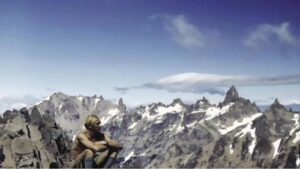
BARILOCHE, Argentina – While much of haute skiing culture in South America has moved 600 miles north toward ritzier resorts, such as Portillo, Chile and Las Leñas in Argentina’s wine region of Mendoza, the mountain town of San Carlos de Bariloche, (the “Switzerland of South America,” and the gateway of Patagonia), and Cerro Catedral, along with its the backcountry refugio system in Argentina’s first national park have far richer immigrant histories and have much deeper roots in the skiing culture of the continent.
BARILOCHE’S EARLY HISTORY
OSVALDO ANCINAS, (Argentina’s immortal alpine skier, a 2-time Olympian, 1960 at Squaw Valley and 1964 at Innsbruck, and gold medal winner of the 1964 games talent contest for his singing, yodeling, and guitar prowess):
Oh, how we used to sing together! Bari-lo, Bari-lo, Bari-lo Che! Che! Bari-lo, Bari-lo Bari-lo Che! che!
YOUR AUTHOR:Â Catedral’s birth and infancy are inextricably tied to the growth of the town of Bariloche, which translated from the Mapuche Indian dialect means “People from the other side of the Mountain.” Cerro Catedral was named for the resemblance of the granite outcroppings to the cathedral spires of European Christendom.
Argentina, like America, is a melting pot, especially Bariloche. German and Swiss migrants first arrived in the town before the 20th century dawned, bringing many architectural, cultural, and gastronomic influences that came to define the region. During and following World War I, Italians and Slovenians followed, leaving behind the political and financial chaos, but still reveling in a mountain region as gorgeous as their beloved Alps and Dolomites. By the late 1940s, Bariloche had grown from a remote regional outpost of 3,000 inhabitants to a bustling city and Patagonia’s leading tourist center, receiving around 55,000 visitors yearly at that time, becoming Argentina’s epicenter of skiing and hiking. And after World War II a further influx of Europeans, both Axis and Allied alike, came to start a new life that both looked and felt like the pre-war lives they’d left behind.
RUBEN MACAYA, (Beginning in 1951, Ruben lived in Catedral’s Refugio Lynch with his mother for nine years. Later, as a professional international winter sports star, Ruben once lived for 30 years without seeing a single summer. He competed for Argentina in the 1968 Olympics, then later became coach of the U.S. Men’s Ski team):
The first settlers landed in1891, mostly Germans and Swiss, and then the Austrians came a little later, although Austria was part of greater Germany at the time. A German named Ricardo Roth had the concession to the road and boats that transported people back and forth between Chile and Bariloche. On the Bariloche side was Carlos Weitherholdt, the supposed founder of Bariloche who was also German. But the commerce was all done — and Bariloche got all its needs – from Chile. The Pampas — the steppes – were so far away and it was like crossing the desert, like Colorado, New Mexico and Kansas. And the mountain passes were too high. The old pass that the Indians used went through the lakes. That’s the pass that Bariloche used for all its commerce. Otherwise, it was stagecoach and caravans of oxen-pulled wagons. Connection to Buenos Aires was a month-and a half or two. Connection to Chile was just four or five days until the railroad was finished in 1934.
The original plan of an American railroad guy named Bailey Wills and the Minister of the Interior, Ramos Mojilla, was to found a Nahuel Huapi Industrial City which is not where Bariloche is, but on the other side of the Limay River on a huge, HUGE esplanade where they figured could fit a city of 600,000 people. Had they done that, with all the riches Patagonia has, Argentina would be much richer, with all the wool from the sheep ranches. And Bariloche was going to be a little, cutesy touristy town, like Carmel or Aspen. Unfortunately, they didn’t follow the Gringo’s idea.
YOUR AUTHOR:Â Also, the war halted investment by Europeans and American financiers. Argentina profited from the war by exporting beef and horses for the European armies.
OSVALDO ANCINAS: Not only does Argentina have the fastest horses. They taste better than the European horses!
(Laughter)
RUBEN MACAYA: But when the railroad was finished in 1934, that’s when commerce changed 180 degrees, everything came from B.A., and Bariloche became a tourist town, because you could take the train without needing several days to get there.
YOUR AUTHOR:Â Now, almost a century later, close to a quarter of a million inhabitants live in greater Bariloche, and as the gateway to Catedral, it welcomes over 600,000 tourists in winter alone. Best of all, the European influence still shines brightly, everywhere from torchlight descents down Catedral’s slopes during Winter Festival (Fiesta de la Nieve) to the Veal Milanese being pounded in front of you in the mountain refugios for your lunch, to locally made chocolates that would knock the socks off Ferrero Rocher.
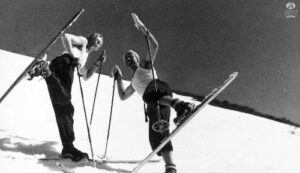
Photo credit: Patagonaian Historical Society
THE FOUNDING OF CERRO CATEDRAL AND THE FIRST SKI TRACKS IN THE REGION
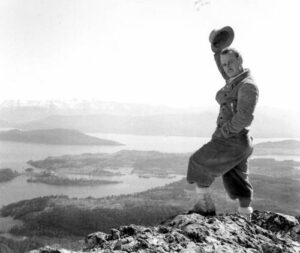
YOUR AUTHOR: Patagonian skiing dates back to the 1931 founding of the Club Andino de Bariloche by pioneering German climber Otto Meiling, Argentinean Juan Neumeyer, European immigrant Reynaldo Knapp, and Swiss-trained surveyor Emilio Frey, who became the first superintendent of Nahuel Huapi National Park. Club members built seven refugios that continue to shelter skiers and climbers throughout the millions of acres of wilderness in both summer and winter. Catedral’s roots were planted shortly thereafter; in 1936 the then National Parks Directorate, under the leadership of Ezequiel Bustillo, entrusted the Austrian skier Hans Nöbl with the task of determining the suitable location for establishing an internationally renowned winter resort in one of the mountains in the region. Born in Tyrol Nobl came to Argentina in 1936.
BELEN JONNSON, (Former Public Relations Manager for Catedral Alto Patagonia Resort):
Nobl had consulted with the design and construction of Italy’s, Sestriere, Piedmont’s jewel, and later host of the 2006 Torino Winter Games. He had also served as the director of their trailblazing ski school for several years. Due to his experience in Europe and his meticulous vision, Nöbl designated Cerro Catedral as having the best conditions.
RUBEN MACAYA: So Nobl was invited in 1936 by the National Parks Office. These were all wimps from Buenos Aires who had been to Europe and wanted to build a ski resort in the mountains. He came to B.A. and he conquered the elite, and he was very knowledgeable. He came to Bariloche and he chose well.
ROBERTO TADDEO, (Another well decorated w Argentinian winter sports champion):
Nobl found Catedral. There were two other locations he considered, but at one of them you would have had to take a boat the get to the ski resort, and the other was closer to the Chilean border than Bariloche, and so they ruled it out.
Nobl was handsome had long blonde hair, and was very skinny. He was charming in his own way.
VICENTE OJEDA, (An Argentinian ski champion who began at age six on a wooden pair carved by his father. At age 12 he entered into Catalina Raynal’s ski school, along with a team that included three more well- decorated champions. Vicente won the downhill at the 1952 South American Championships):
He was tall and very skinny with big blonde hair. He was classy dresser and an elegant skier. People didn’t really like him; he was arrogant and business-like pinching money wherever he could, so people were a little wary of him. But he did a lot for the town of Bariloche, and we got Catedral because of him.
YOUR AUTHOR:Â Nobl’s choice bore sweet fruit almost immediately. He directed the construction of a tram and the mid-mountain Refugio Lynch in 1939, before most skis had metal edges. In 1940 the first drag lifts were designed and installed at Catedral, running from the base area to an altitude of 5,600 feet. Two years later, the first refuge on Cerro Catedral was completed, with the concession managed by (CAS), on what was then the highest point on the mountain.
Funded primarily with National Park money. the mountain and resort were within the national park. They built the roads and infrastructure, at times carrying loads up the mountain by foot. They also began program where they’d ask for private investment for hotels within the park. In one case, an Italian dowager, the Contessa Gambona paid for and built the Hotel Catedral, and in 1944 the first base accommodations were opened to Buenos Aires elite.
What a heady, halcyon time it had to be:Â The birth and emergence of a nation’s nascent skiing scene.
RUBEN MACAYA:Â There was also Benito Moreno. He donated some lands to found a national park. Parque Nacional de Sur, the first national park in South America, and the third in the Americas. The National Parks Office was incredibly powerful at that time. And they decided to make Bariloche a touristy, European-looking town. That also was built with National Park money.
BELEN JONSSON:Â Dr. Antonio Lynch was another driving force behind the introduction of skiing not only at Catedral, but the entire region of Patagonia. His name adorns the winter sports center, a refuge, a slope, and a chairlift. Lynch, an active sports leader who was then president of the Argentine Ski Club, promoted the creation of the Argentine Ski and Mountaineering Federation.
VICENTE OJEDA:Â Lynch was B.A. high society and senior official in the National Parks Department and worked closely with the Director Bustillo. Lynch contributed to the building of Catedral and the first Argentine ski club. He also built the refugio system, clearing all the woods by manpower at first. The lifts were held up by the war.
RUBEN MACAYA:Â Four or five of them they founded Club Andino in 1936. And Antionio Lynch and others founded Club Argentina de Ski in 1938. Carlos Oertle was also one of the pioneers of Catedral. He ran the Club Andino at the bottom of the mountain. One of the first settlers to the area of Catedral, he had the concession for the lodge, and my mom worked as a cook for him there as she had moved from the country.
Carlos ended up being like a grandfather to me. When she got the job cooking at Refugio Lynch, at that time is was a five star lodge; the whole thing was unbelievable. All the chairs and sofas were cowhide, it had paintings from famous European and South American painters, and the chair were hand hewn and hand painted: the place was first class. When my mom got there, she said, ‘Oh, my God! Where have I landed? This place is fantastic. It had 15 beds in three big rooms, one for women and two for men. It had room for 15 women and 28 men.
That’s why I’m here — I wouldn’t be here but for skiing.
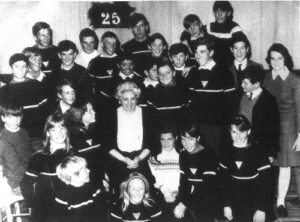
CATALINA REYNAL — “LA MADRINA”
OSVALDO ANCINAS:Â I started skiing in 1944 when I was 10 years old. We had a 1,500-meter surface lift, and the old cable car that was installed in 1950 took us up. That car was built in Italy in 1938, but it sat on the decks until the end of the war because they afraid of the German U-boats.
I remember the date:Â August 7, 1944, because I started skiing at the school of Catalina Reynal. The Reynal family were wealthy rancheros. They had horses. Catalina Reynal was concerned that the children of the community couldn’t afford the equipment to ski or have an opportunity to learn it as a sport. She wanted the children of that community to learn. So she’d take all the kids up to the mountain from Bariloche in a truck with a cover on it. They had 18 feet of snow at the bottom of the mountain. They did it in Europe before. She always told me bariloche needed to keep the kids busy with skiing. She and another man named Antonio Pelligrino — he got together the skis and boots and such. What a wonderful woman! She and Antonio were how I learned to love to ski. She introduced me to the sport I still love today.
YOUR AUTHOR: She was “La Madrina del Esquà Patagónico” – the Godmother of Patagonian Skiing, a true trailblazer in the realm of social skiing.
RUBEN MACAYA: I had a conversation and tea with her at her home one time before a trip to Europe, and I asked her what drove her to help the kids, and she said that at the time, when you went to Hotel Catedral it was just the elite of Buenos Aires. And she felt that it was just the wealthy of Buenos Aires that were a part of it, and that the locals were shut out. ‘How can the locals learn to ski if we don’t help them?’ She got instructors and people to work on the mountain. She was a visionary in that regard.
INSTRUCTORS FROM ACROSS THE GLOBE
RUBEN MACAYA: The first two were Hans Nobl and Otto Meiling, and they did not like each other. Hans was more interested in big money and exposure whereas Meiling was a real mountain man, he despised the wealthy people of Buenos Aires. His school was for the people, whereas Hans’s was more for the [elites].
OSWALDO ANCINAS:Â Also Dinko Bertoncelj; he was from Slovenia. He became the head instructor for CAS. He was always with the daughter of the Italian [Contessa della Gambino] who owned the Hotel Cathedral. She raced for Argentina.
YOUR AUTHOR:Â At the end of World War II, Dinko Bertoncelj was 16 years old. When his father was shot, he fled from Slovenia to Austria and spent two years in a British-run refugee camp. He managed to climb and ski and was encouraged by an Austrian coach to imigrate to Argentina. Bertoncelj was still a teenager when he landed in Bariloche but soon became a leader in the mountaineering community, putting up first ascents and joining expeditions to the Himalaya and Antarctica.
RUBEN MACAYA:Â [Dinko’s] first job was as the guy who runs the boilers at the Hotal Catedral. He was a skier already in Slovenia, and then he worked the boilers at the hotel and skied with the family that owned the concessions. And then he became and instructor after that. There were so many Europeans in Bariloche, they were teaching each other to be instructors.
OSVALDO ANCINAS: And Andres Nowortya, another wonderful instructor, he was from Poland. He’d’ say ‘YOU GOTTA BEND YOUR KNEES SOME MORE OR I’M NOT GONNA TEACH YOU ANY MORE!!!!!’ That was the kind of character he was; he loved the mountain.
(LAUGHTER)
And then we had another coach, he’d say, ‘We’re going to the mountain to be away from everybody and be closer to God.’ And we walked. We carried everything by foot. Even as a small boy, standing up with snow up to my chest!
We were the first members of the ski patrol in 1950-51.
RUBEN MACAYA:Â There was also Gustavo Camara an early director of the ski school.
BARILOCHE AND CATEDRAL TODAY
OSVALDO ANCINAS — A friend of mine told me recently there were 21,000 people skiing on the mountain on one day. And when I left Bariloche in there were only 25,000 people living there. Now there are 160,000. It’s a big change. And now at the Refugio Lynch, they ski by at 100 miles an hour! When I was young, you had to watch out because the foxes would steal your lunch!
(LAUGHTER)
RUBEN MACAYA:Â Yes! Once, years ago, the foxes actually ate through the cables of the Tram!
But it was the expansion of the mountain in the ‘50s that was the next huge development. Besides the cable car and two lifts they already had, they built three new chairlifts and one long T-bar to service another summit of the mountain that opened up a whole bowl east of Refugio Lynch. William Reynal was a genius of marketing. He owned not only Lagos del Sur, which developed Catedral, he also owned Astral Airlines and Sol Jet, a tourist company that tried to democratize skiing. They’d fly normal passenger routes during the day, and all night — 1 o’clock, 2 o’clock, 3 o’clock he’d fly skiers to the mountain and they’d stay in his hotels in both Bariloche and Catedral. All of a sudden, skiing exploded. That started in 1967.
OSVALDO ANCINAS:Â Yes, and it was Vicente [Ojeda] that told me when they’d come — many of them from Brazil – they had never seen snow before. They’d walk out into the streets of Bariloche in their pajamas taking pictures of the snow.
And Catedral is not only the most beautiful lakeview area in the world, it’s the most beautiful ski area in the world period.
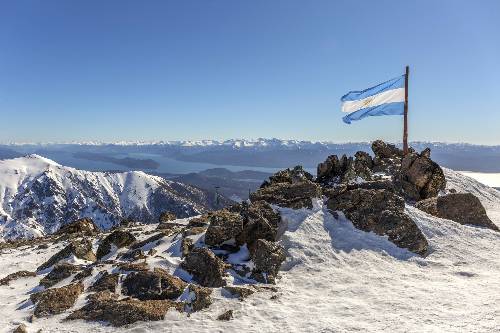
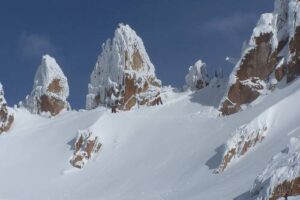
YOUR AUTHOR:Â By day you joyously shred 1,500 acres of in-bounds terrain and another 1,500 acres of back country, much of it with stunning views of colossal glacially-carved lakes dotted with islands, smaller alpine lakes, the thousand-year-old deciduous and evergreen forests, and volcanos in both Chile and Argentina. (They still occasionally erupt.) Upon bootpacking a few thousand feet through a notch off the summit’s backside, there are millions more acres of pristine national park backcountry easily accessed. Sunrises and sunsets ignite the silhouetted mountains of Patagonia in a fireburst of red, orange and gold. And by night a billion stars illuminate the lazy haze of the Milky Way.