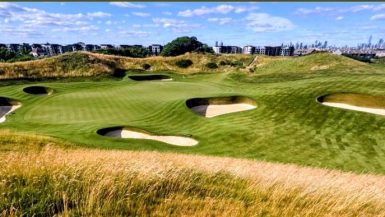


CLIFTON, NJ – For a club that’s 110 years old Upper Montclair still has the vitality of a twenty-something. They’re the only club in America to host professional events from all three U.S. tours, (PGA, LPGA, Seniors). They have 27 holes of Robert Trent Jones, Sr. golf over a routing laid out mostly by A.W. Tillinghast. They just finished a $6.2 million renovation spearheaded by a John Harvey master plan. And they just celebrated the wonderful career of Steve Kozak, a 90 year-old caddie who has served the club for 41 years continuously.
“It’s a wonderful club I remember well from my youth,” beamed no less a personage than Robert Trent Jones, Jr., himself a world-class architect and Number 1 Son of the man who redesigned all 27 holes. “One of my favorite memories was playing in the N.J., State Amateur as a junior and I had to play Martin Standovic, the great golf gambler from Atlantic City, and he was a little worried not only because he had to play me in a high pressure situation, but he had to play me at my dad’s course, and we were playing for honor, not money!” he recalls. Jones put up a great fight, losing 2-1 to one of the greatest money players of that generation.
In truth, any tournament is a daunting prospect at Upper Montclair. The South and the West nines form the tournament venue that has beguiled the likes of iconic pros Arnold Palmer, Jerome Travers, and Jack Nicklaus, and celebrities Jackie Gleason, Babe Ruth, and Annie Oakley.
“You have to hit the ball straight, and you need to work the ball both ways,” explained former club champion Claudio Kawecki. “You’re going to take penalties, and you have to play smart so as to minimize mistakes. Fairways are narrow and bunkers pinch the landing areas and greens. This is a shotmaker’s course. That probably explains why so many great names like Arnold Palmer and Nancy Lopez have won here.”
“The other great aspect of the course is the greens,” added club president John “Jack” Voynick. “They have both micro and macromovement,” he explained, referring to not only large, easily seen breaks from the visible contours, but also the subtle movements caused by the nature of the terrain.
Indeed the course is a stern test: not from overbearing length, but from narrow tree-lined fairways, deep penal bunkers, and the cunning greens. The West is the most difficult nine, featuring the smallest, most heavily guarded greens and the narrowest, tree-flanked fairways. It’s typical Jones penal architecture on the usual parkland site on which he designed. Some Tillinghast features remain like the excellent “Great Hazard” bunker on the par-5 seventh, a broad and deep cross-bunker about 70 yards short of the green, though the course is certainly features more of the hallmarks of Jones’s work.
In fact, while all the par-5s are showstoppers, and constitute the best holes on all three nines, the two on the West are the centerpieces. They are not only the best two holes on the West, but the best par-5s of all six par-5s at Upper Montclair. The par-5 fourth hole is a sharp dog-leg featuring a drive over water that must fade or run through the fairway. Then the hole plays through a chute of trees and along one border of the property to a green fronted by water.

The South nine features the most varied terrain and interesting holes. Your author’s favorite at the club is the par-4 third, also the number one handicap hole at Upper Montclair. A long dog-leg left, aim for the gorgeous Japanese Maple tree in the distance and hit a big draw around the corner. Then play the second shot from about 180 yards to a green open on the left, but guarded by sand and water in the right.
“That’s also the hole that features the most options,” added AWITP photographer and technical advisor Bruce Moulton. “That’s a brilliant hole.”
The South also has the best par-3, including the idyllic sixth, which is shorter than most par-3s at the club, but features an approach over water to a green bunkered on the left.

The par-3s do present a dilemma as they all play around the same distance (for example, 165-195 from the tees most men play from, 180-210 from the tips). There isn’t a single outstanding short par-3, and most of them not only play similarly but look roughly the same, 6 South being the lone exception.
Additionally, one finds himself wishing for a little more variety in terms of a good “half-par” hole, such as an interesting drive-able par-4 or reachable, tempting, but dangerous par-5. But again, Jones, Sr. not only created excellent holes for a pre-eminent private club, but also produced a course that could host a tournament and test the best players of the game. Moreover, such half-par holes were simply (and sadly) not in vogue during Jones’s heyday.
“It’s a period piece,” said Bob Jones, Jr., “but it’s an excellent tournament venue and competition course. It’s like the Old testament proverb about getting into Heaven – ‘straight through the gate, narrow is the way (as in fairway), and few there are that will make par.'”
Finally, the club could prune a few of the trees. 4 South is a delightful short par-4, but half of the fairway is blocked out by an enormous tree, effectively cutting the fairway in half and punishing a good drive. The tree is so huge and so low, you cannot shape a short iron around it, so you are completely snookered even though you hit the fairway. Not everyone has the precision of a tour player off the tee, and it seems more fair to punish a player who hits a good drive to the fairway from 240-260 yards away with, instead, a poorer angle to the green or perhaps a deeper bunker.
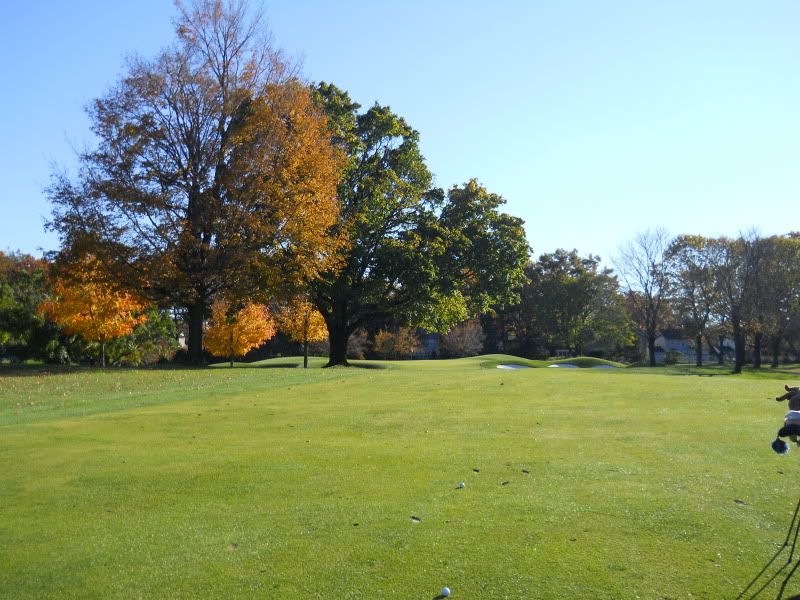
The South closes with a terrific showstopper of a par-5, with a thrilling approach up to the clubhouse with the green guarded by water on the right and bunkers on the left. It’s a wonderful hole to complete the round and the day.
The East side is the most charming nine, and feels the most pastoral. Once again, the doctrine of symmetry was employed – two par-5s and two par-3s – but the fairways are wide and the green contours more subtle. It had the homespun, rustic feel of the back nine of another Tillinghast masterpiece, Philly Cricket Club.

The club is a great place for a local to hang their hat, especially if they are a talented golfer looking for a challenging place to prepare for tournament play. There are many excellent players at the club – Kawecki, for example, who recently beat out 23,000 other applicants to become Davis Love III’s caddie at a recent Fall Series event. Moreover, the greens are excellent, rolling perfectly true and featuring interesting contours. An excellent caddie, such as Steve Kozak or Kevin Baker, will be a great help as there are frequently double-breakers. Baker was especially sharp all day long with his reads.
Steve Kozak – in his own words
He’s 90 years young, been a 41-year veteran of the club, and has served his country twice, during World War II and Korea. Humble, sincere, and dedicated, Steve Kozak is the gold standard of caddies and has served the club through five different decades.
On Upper Montclair:
“It’s a great club with great members and great friend of mine among the caddies. It’s a nice place to work.”
On holes-in-one:
“I’ve seen two – one on 5 East and one on 8 West. That’s a tough hole to get one too.”
On serving his country:
“I’m very proud to serve my country. I was at Iwo Jima and that was the scariest moment, but also the one that I remember most and that was the most important.”
On the most important duty of a caddy:
“Don’t lose your player’s ball.”
On the funniest thing he’s seen in his 41 years:
“Some guy trying to hit a ball out of six inches of water. Good luck.”
On the wonderful party they threw to celebrate his turning 90 years old and his 41 years of caddying:
“Thank you so much. I just so grateful and glad you like me.”
Jack Voynick in response:
“No Steve – we love you.”