

SOUTHPORT, MERSEYSIDE, ENGLAND – This will be a fascinating year to watch the statistics for individual golf holes, because Royal Birkdale and the R&A believe that they – with the help of golf architect Tom Mackenzie – may have solved a pesky issue. For decades, the book on Birkdale was simple: go low on the outward nine while the prevailing wind is with you, then hang on for dear life coming home into a gale.
But Tom Mackenzie has made changes, especially to the par-3s, now allegedly much more difficult, especially the 15th, now a brutish 241 yards, playing longer now that the prevailing wind has reversed.
“I thought I needed to hit driver, but then I thought I can’t do that on a par-3,” joked Scottie Scheffler, whose 2-under 70 places him three shots behind first round leader, American Jackson Suber.
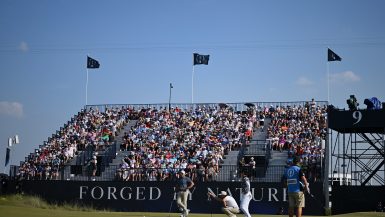
“I’ll tell you the worst thing about the new 15th,” offered quintessential UK golf writer John Hopkins. “The placed an enormous hospitality tent behind that green, completely obscuring the view of the course and clubhouse as a backdrop.
That may prove interesting come late Sunday afternoon when the patrons are several Guinnesses deep and an Englishman is coming down the stretch with a chance to win.
Indeed, the par-3s are not only where the greatest changes to the golf course occurred, but they are all difficult. Requiring the utmost in strategy and then execution.
“The par-3s are no place to be firing at pins,” confided a member of both Royal Birkdale and nearby Formby, another sparkling seaside links in England’s fabled northwest Golf Coast. “In fact, rule number one this week at Birkdale should be no firing at pins at all. And the second most critical piece of advice is hit whatever club you need to avoid the bunkers off the tee.”
Only 23 of the 156 players in the field managed to score under par cumulatively over Royal Birkdale’s collection of par-3s. None of them ranked lower than 10th in difficulty and the aforementioned 15th -playing to a scoring average of 3.26, was the 4th hardest hole on the course for the first round, while the fourth hole, the sixth hardest on the day, played to a stroke average of 3.25..
As for balancing the two nines, it’s highly possible the R%A and renovation architect Tom Mackenzie accomplished the task. Par at Birkdale is 34-36=70. The front nine played to a scoring average for day one of 34.87 – .87 strokes over par. Yet the back nine played to a scoring average of 36.57. So, the front nine actually played to 1/3 of a stroke harder than the back nine.
There are still three rounds left, but if that form holds, Mackenzie will have evened the two nines in difficulty. He may even have flipped them.
Still, our member’s advice holds true for the field this week. Choose your places to try to attack carefully as Royal Birkdale’s prodigious bunkers and gnarly, thick rough dole out impossible lies and even penalty strokes for those off-line.
Right off the bat, Birkdale begins with a long, sharp dog-leg, reputedly and potentially the hardest opening hole on the Open Rota. With dry, firm conditions, driver is certainly not the choice as running into a bunker or the rough is likely should the player fail to hit a long draw. Yesterday, most players chose an iron to lay evenly alongside the left hand bunker, though it means a long shot coming in.
In 2008, Greg Norman tried some gamesmanship with eventual winner Padraig Harrington, with whom he was paired.
“In the final round in 2008, I stood up on the tee with an iron, and Greg Norman had a driver in his hands up until it was his turn to play, when he switched back to an iron.”
Such a cheeky monkey that Norman. Little good it did him. Not only did he bogey one, he also bogey the next two in a row on his way to a ghastly 77. Padraig, aided by an eagle on 17, won by four strokes over eventual runner-up Ian Poulter of England. Meanwhile the first hole played .14 strokes over par for the field on Thursday.

Two other dangerous holes require careful precision as to planning and execution. The par-4 sixth measures a whopping 514 yards and played to a stroke average of 6.35. With bunkers on both sides of the fairway and a wind seemingly shifting every which way, players might be best off hitting 3 or 5-wood, but the second shot is much longer and played to a green that at least is receptive to a long shot from a lower lofted club.
Similarly, the 18th, now a gargantuan 508 yards was second hardest at 4,33. Worse still for the golfers, the tee has been shifted and the hole narrowed, bringing four right fairway bunkers and two on the left into play significantly more. Anything too far right also risks gouing out of bounds.
“It’s often about holding a shot into the wind and playing for the middle of the green,” added Harrington. That’s a tough way to finish, especially with the Claret Jug in the balance. Remember Tom Watson hit 2-iron in 1983 at 18 to secure his fifth and final Claret Jug.
He put it two feet from the flag. What a capstone to five Open victories. If only he hadn’t three-putted the 72nd at Turnberry in 2009…
As for birdie opportunities, it’s the three par-5s and the drivable fifth hole where the contestants must try to make up ground on the field. The only par-4 to pl.ay under par, the 321-yard 5th played to a 3.755 stroke average and surrendered 71 birdies – not quite half the field, but not far off either.
The back nine par-5s, 14 and 17 – the only par-5s on the course – were also ranked 16th and 17th hardest respectively, surrendering 51 and 65 birdies each. The 14th played to a stroke average of 4.88 and the 17th to just 4.68. Players were not scared of the yardage at the new 14th – 602 yards – as the wind was with them yesterday. 17 has always been a hole where birdie and even eagle is possible. It will play a crtitical role on Sunday to determine the winner. Anyone making par or even – GASP! – bogey will have likely blown their chance to claim the Claret Jug.
NEWS, NOTES AND QUOTES
As we go to press, with the morning wave playing the back nine, Australia’s Lucas Herbert just posted a record 28 on the front nine in round two. Apologies to the great Ian Baker-Finch. By contrast, first round leader Jackson Suber carded a 36 on the front and fell three shots behind at their turn. Hebert leads by two shots at seven under, but his round is still underway, but more importantly, we may be on a 61 watch…perhaps even 59…at a major…