

SOUTHPORT, MERSEYSIDE, ENGLAND – Agincourt. Westminster Abbey. William Shakespeare. Lord Nelson. Elizabeth the Second, The Beatles, The RAF. Wimbledon. High tea. Royal Birkdale.
What do they all have in common? They are all iconic gifts of England.
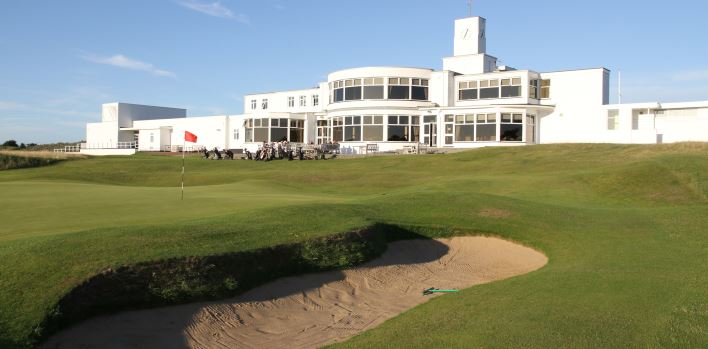
Royal Birkdale may be one of the younger additions to the Open Rota – its first Open was 1954 – a mere 72 years ago. By contrast, St. Andrews held its first in 1873. But Birkdale’s welcome habit of often crowning golf’s true immortals – the dominant golfers of their age -combined with its inimitably English trappings makes the course one of the best Open venues for everyone, players and spectators alike.
“Any golfer will tell you they love playing over here,” gushed two-time and reigning U.S. Open Champion Wyndham Clark. “The fans really respect the game, they respect the players, and they really understand golf. If you hit it into a tough spot and make the correct play or the smart play, the prudent play, they clap; they understand sometimes 20 feet is a great shot.”
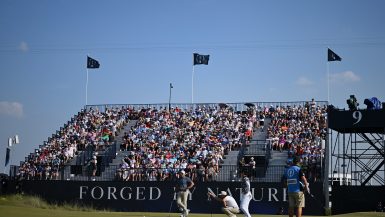
Birkdale is indeed the friendliest venue for the spectators. Besides the ubiquitous grandstands, the towering dunes line the fairways offering perfect sight lines for the fans on nearly every hole. The scintillating town of Southport glimmers by the seaside and for those seeking fun and adventure, Liverpool is right next door.
The Open Championship is totally civilized. And Birkdale, along with Royal Lytham and Royal Liverpool, is its zenith in that regard.
When Birkdale debuted in 1954, it could not have asked for a more sterling champion; Peter Thomson, the grand Australian with the sporty comma of a pompadour hairstyle won his first of three consecutive Claret Jugs here as well as five overall, one short of Young Tom Morris’s all-time record. Actually, it was “Bookends at Birkdale” for Thomson, as he won his fifth and final Open here in 1965. Indeed, though South African Bobby Locke was often Thomson’s foil, for a seven-year stretch no one played better at the Open than Thomson. He netted four Claret Jugs and finished second three times between 1952 and 1958. Interestingly, Bobby Locke won two of the Opens where Thomson finished second – 1952 at Royal Lytham and St. Anne’s and 1957 St. Andrews.
Next came Arnold Palmer in 1961, his first of back-to-back Open victories. His fabled 6-iron to the 15th green from deep in some of Birkdale’s most fearsome rough is still regarded as one of golf’s most historic shots.
But more importantly, Palmer’s commitment to play the Open Championship lit the fuse that became the explosion of American players embracing the Open. Led by Palmer, the Open Championship’s stature in America grew to major championship proportions. And it was Palmer himself who told the press, “I consider the four majors to be the PGA, the Open, the U.S. Open, and the Masters. More than any single victory, this may have been Palmer’s most lasting achievement.
After Thomson claimed his fifth and final Open Championship in 1965, Lee Trevino was next, winning in 1971 with both his golf clubs and his jokes. Just one year earlier he held the lead at St. Andrews entering the third round. But at the fifth hole, Trevino made the cardinal mistake of hitting to the wrong flag on the enormous Old Course double greens. The resulting three-putt – from about 150 feet, dropped him from contention, leaving the stage to Jack Nicklaus who defeated the flamboyant Doug Sanders in an 18-hole playoff.
But Trevino would get revenge on Jack…revenge in spades, in fact. The Merry Mex soundly defeated Jack in an 18-hole playoff for the U.S. Open title at Merion a month earlier]. Jack’s wedge never got out of the trunk of his car, and he trailed by three early and never recovered.
Then in 1971 Trevino held off a puzzling stranger in a porkpie hat named Lu Liang-Huan, a golfer obscure even in his own country of Taiwan. The British papers dubbed him “Mr. Lu” Though most golfers and fans had never heard of him, and would never hear of him again on the PGA Tour, Trevino was certainly acquainted with him.
“I used to play with him in ’59 when I was a Marine in Okinawa. He never misses a fairway. I played him I n Taiwan one day and he reeled me in 8 and 7,” Trevino recalled at the time.
And then, as only Trevino could get away with, he joked to the assembled media, “I’m gonna send him back to the laundry.” Metaphorically, he did, posting a 68. The victory culminated a season where Trevino won the U.S. Open, the Canadian Open and the Open Championship. Of course, Trevino had a joke for the occasion.
“Is there a Mexican Open this year? If there is I’ll be there!”
Mind you, that’s coming from the man who also said, “I know I’m a Mexican, but now that I’m winning tournaments, I think I want to be a Spaniard!”
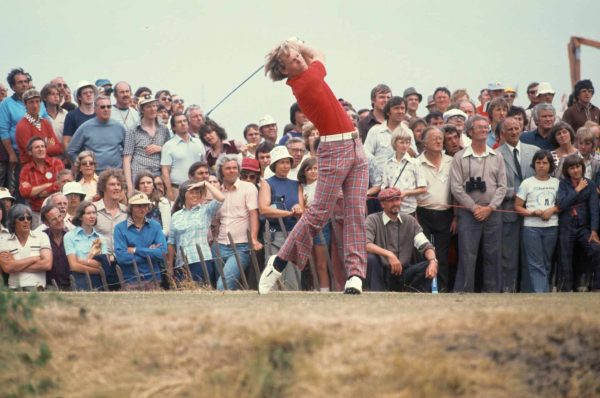
Exactly fifty years ago, in 1976, Birkdale again crowned the dominant golfer of the time. Johnny Miller, with his blond hair, Hollywood good looks, and silky-smooth swing. The Open at Birkdale was his second and final major after being unstoppable between 1973 and 1976. In ’74 alone he won eight times and took home Player of the Year.

Then again in 1983, Tom Watson took home the last of his five Claret Jugs, on five different courses, no less.
“He’s won more than Bobby Jones!” gushed preeminent sportscaster Jim McKay as Watson hoisted the Jug. Watson joined legendary UK golfers James Braid and J.H. Taylor, names that materialize from the mists of time.
Meanwhile, at the 14th hole on Saturday, Hale Irwin stubbed his putter and whiffed at the golf ball while trying to tap in from one inch…one inch. He lost by one stroke.
In other oddities from the week, Bill Rogers holed a 1-iron for an albatross on the first day, and Denis Durnian, a club professional from Manchester, set a new record of 28 for the first nine on the second day, missing from 10 feet at the ninth for a 27.
While no one would confuse either 1991 champion Ian Baker-Finch or 1998 champion Mark O’Meara the premiere golfers of their era, both are nicest guys ever and fan favorites for the affability. Everyone loves Finchy, the kindly, charming Aussie who went on to what many hope will be a Hall of Fame broadcasting career. And O’Meara was so likeable Tiger Woods, who lets no one get close, became his close friend.
That’s a life accomplishment.
In 2008, the ghastly weather was the story. It rained bricks and bats. Temps were freezing, and squalls rolled off the Irish Sea. But even though he opened with a 74, Padraig Harrington wasn’t worried.
“I don’t like playing in bad weather, but it gives me an advantage,” Paddy confided, “Because half the field psyches themselves out, and it gives me more of a chnce. I only have half the field to beat.”
Still, three days it looked as though Greg Norman had found the fountain of youth, hanging so tough in the foul weather, he actually led the tournament at age 54 as the final round dawned. But Harrington authored a brilliant 4-under 69 on Sunday as Norman ballooned to 77, and Harrington became the fifth player in the last 50 years to claim back-to-back Claret Jugs. Harrington would go on to claim the PGA Championship at Oakland Hills a month later

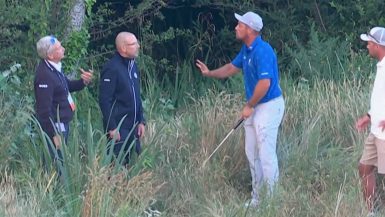
And then, in 2017, we witnessed “the shot.” Jordan Spieth hit his tee shot on the 13th hole so far right, he had to drop between parked equipment vehicles. But seemingly from Hell itself, Spieth smashed a mighty blow with a 3-wood, clearing a gaping expanse shaggy dunes to finish greenside for a round-saving bogey. It was reminiscent of Seve Ballesteros’ historic “Car Park” stroke at Royal Lytham in 1979. Spieth then went 5-under over the next four holes to zoom past Matt Kuchar like Matt was standing still. But it was the shot on 13 from nowhere that will be replyed as long as there is a Royal Birkdale.
Doubtless, Birkdale loves drama, and we in turn are captivated by it, mesmerized. With such quintessential Open history. Birkdale is, deservedly so, the pride of English golf, rightfully standing shoulder-to-shoulder with any and all other British icons. Rule Brittania, and rightfully so.