


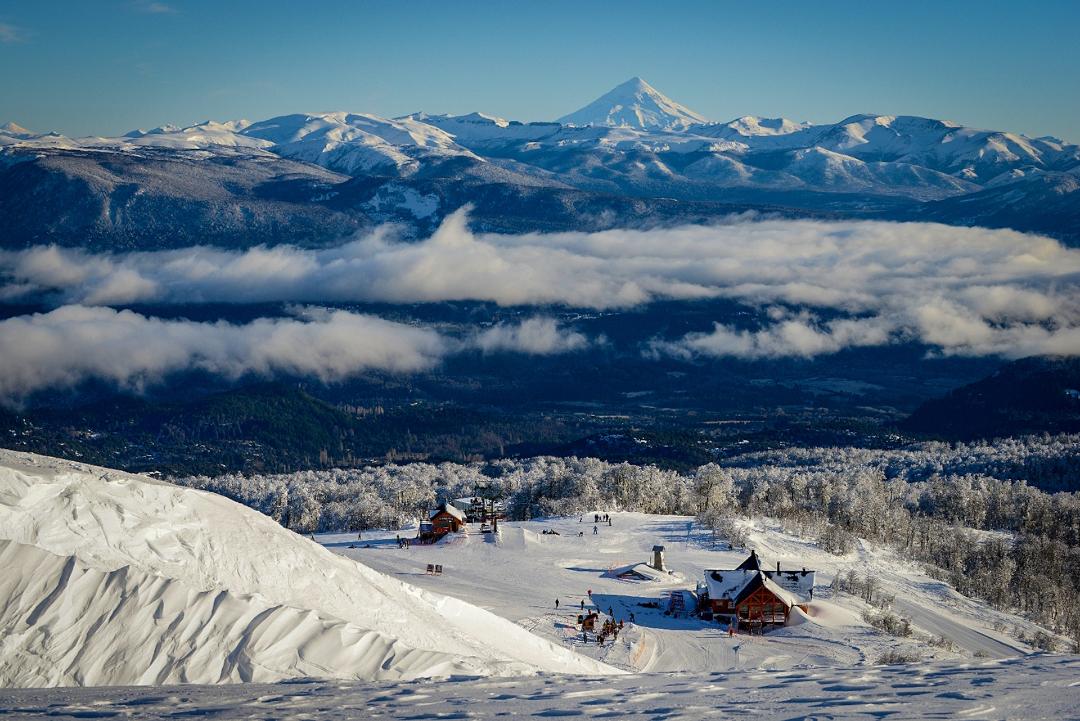
Small but mighty, on two different continents one global mission of sustainability is championed by the unlikeliest of mountains. Deep in the heart of the Andes, Cerro Chapelco has been at the vanguard of implementing a zero-carbon footprint since 2017. Meanwhile at home, western Massachusetts’s Jiminy Peak has carried on its pioneering green tradition since 2007. And in both cases, a Lilliputian resort is making a Brobdingnagian impact.
CERRO CHAPELCO – SAN MARTIN DE LOS ANDES, ARGENTINA
Patagonia is an antique land. The Andes stretch, a timeless ocean of mountains proceeding wave after wave into the horizon, while dusty Route 40 meanders circuitously through the glimmering Lakes District. A small ski area tucked sleepily in these mountains near the Swiss-style resort town of San Martin de los Andes might be a most unusual place to find the winter sports world’s most technologically advanced renewable energy system, but it’s there, at tiny, but plucky Cerro Chapelco, and it should be the envy of every major resort that seeks a zero-carbon footprint.
“If Cerro Catedral is Jackson Hole, then Chapelco is Grand Targhee,” was a common refrain one hears from skiers and boarders on both sides of the equator. It’s mere 31 trails may seem miniscule compared to other Argentinian resorts, but Chapelco boasts a strong 2,363-foot vertical drop from its 6,463-foot summit. Moreover, Chapelco has won Ski Resort Magazine’s coveted Best Ski resort in Argentina award four of the last five years, besting much larger and more notable places like mighty Catedral, fabled Las Lenas, and the southernmost ski area in the Western Hemisphere, Tierra del Fuego’s Cerro Castor.
But it’s their commitment to a zero-carbon future that vaults Chapelco into the conversation of world bucket list destinations for every skier and snowboarder on the planet.
Chapelco’s road to complete reliance on its own generated renewable energy began in 2017 when it collaborated with internationally-renowned non-profit entity Protect Our Winters, (POW). POW works to raise awareness about the consequences of climate change in the sports industry. Founded in 2007 by Hall of Fame snowboarder Jeremy Jones, their influence and activism have grown to a 15 country-strong global alliance of scientists, activists, athletes, and brands, influencing policy and promoting a change to renewable energy across winter sports venues globally. In 2017, POW selected Chapelco as its only resort partner in South America, due to Chapelco’s committing itself to a totally renewable future, a relationship that continues to this day.
Three other alliances were key, all of them with companies at the vanguard of their respective sustainability industries: collaborations with the Sustenator Company for state-of-the-art solar panels, Flex Energy for micro-energy storage plants, and Czervany S.A. for turbines.
In 2018, together with the Sustentator, an Argentinian company specializing in both advising on renewable energy issues and providing solar energy solutions via on-grid and off-grid photovoltaic kits, solar pumps, thermal tanks, pools air conditioning systems, energy backup, luminaire and other equipment, Chapelco installed photovoltaic solar panels at its Trackers and Patrol post, 5,577 feet up the mountain. These 260-watt panels completely generated all the energy necessary to power all the equipment used by the patrollers, trackers and rescuers for the entire 2018 winter, including all VHF radios, cell batteries, and computers for communications and services, as well as led lighting of the shelter. The incorporation of batteries of 12 Volts and 75 Ah provided a range of 24 hours, supplying the power station during nighttime hours.
“We took a fundamental step and we are very happy,” Juan Cruz Adrogué, president of Nieves del Chapelco S.A. stated at a ceremony commemorating the installation. “We began a path that leads us to be a sustainable ski center, where not only energy is generated, but where there is a total awareness of respecting nature. I am convinced that it can be done. I always say that we not only have to settle for not damaging the environment, but we have to think that we have to improve what we already had. We are going towards that goal,” he concluded.

Shortly thereafter, in conjunction with Flex Energy, an industry leader in solar energy, Chapelco installed solar panels with a power of 5,200 watts, distributed in three micro plants – the base area, the ticket office, and a platform at 1600 meters feet. The resort also designed and built a companion storage and backup system. These panels provide solar energy to the entire data, communication, information and services system for skiers even in the event of network failures.
With that, Chapelco became, wall-to-wall, a fully-renewable resort.
Then in 2019 Chapelco added the generation of electrical energy through wind by installing an SFN H1 1KW two-blade wind turbine. The alliance was his time with the leading company in 5he South American wind industry, Czerweny SA.
“Silent, it does not disturb the peace of the mountain. Since it is installed at height, it has protection systems in case of storms, lightning or very strong winds,” wrote Adrogue.
Next, Chapelco and BGH Eco Smart sealed an alliance to renew the lighting in the three emblematic buildings of the ski center with state-of-the-art LED technology, reducing consumption and adding energy efficiency. In the winter of 2020, they completed that renovation in the boarding station and disembarkation station of the Gondola and the track tread machine workshops. All people who arrive in Chapelco take the Gondola to go up the mountain.
In Patagonia it dawns later than in other parts of the planet located further north. By This is why much of the work in these three buildings occurs at night. “We used LED technology to replace 100% of the lighting at the two stations of the gondola, since we set out to provide safety and comfort to both the staff and operates the lifting device as well as visitors – expressed Eng. Martín Méndez Decoud, Business Manager of BGH Eco Smart. We understand that our line of industrial hoods “It is ideal to install in an international level ski center,” he concluded.
The same technology was applied in the maintenance workshops
The equipment installed in the three buildings will produce an average energy saving of up to 60%.
Since this year, Chapelco and Sustentator also added a charging station for cell phones and mobile devices fully powered by solar panels. In the Pradera del Puma lodge you can charge clean energy through USB connections.
Chapelco is just as hip on-mountain as off mountain. Besides outstanding skiing and boarding terrain, they have a dog sled track. You can ski down to the kennels, mush with the huskies, and then nosh on hors d’oeuvres and champagne. (Author’s Note: I tried interviewing the dogs, but they had no comment.)
JIMINY PEAK – Meanwhile, in sleepy Hancock, Massachusetts, an American ski industry pioneer and multiple resort owner Brian Fairbank has been leading the U.S. ski scene into 21st century sustainability for the last 20 years. In 2005, the National Ski Area Association awarded Fairbank the Sherman Adams Award, their highest honor, for his advances in snowmaking technology and in green energy/sustainability. Then in 2007, he drew national acclaim when Jiminy Peak installed a 1.5-megawatt wind turbine. and was recognized by the NSAA in 2008 with their Golden Eagle Award for sustainability.
“It made financial sense for us as a business decision, in addition to being good for the environment,” stated Christie Derby, Jiminy’s Envrironmental Maven. “Jiminy is a large consumer of power and is very conscious of the impact it has on the environment. [We] implemented a number of energy conservation efforts including the installation of the 1.5MW wind turbine that provides Jiminy with approximately 33% of the electrical demands of the resort, especially our Snowmaking System. The [2007] turbine installation is beneficial to help offset the power for our Snowmaking Plant, slope lights and 2 of our 7 chairlifts as well as the central core of our Country Inn.”
More advances and awards swiftly followed. In 2016, the Fairbank Group constructed a 2.3-megawatt solar facility, achieving the milestone of 100 percent usage of renewable energy. All power goes to the grid and is sold back to the off takers in the form of renewable energy credits. The wind turbine located on top of Jiminy Peak does get consumed directly by the resort with any unused power being distributed to the grid. Approximately 200 houses are benefitting from the Community Solar Program, purchasing renewable energy credits that are left over after Jiminy’s allocated portion of half of the production. In recognition of this milestone achievement, in 2017 the NSAA gibe Fairbank its highest honor, the NSAA Lifetime Achievement Award.
“From the feasibility study to the date it went online was about 2 years. This community solar facility is 2.3MW with Jiminy purchasing 50% of the renewable power and the remainder being utilized by approximately 200 homes and small businesses,” Derby explained. “The renewable energy credits from the generation of power at the site goes to our Main Service line for the Resort. This powers our Snowmaking System, Slope Lighting, the Central Core of our Country Inn, Cell Tower and 2 chairlifts out of our total of 6. The solar array generation is in addition to the 33% of the power consumed for these locations from our wind turbine.”
The 12-acre solar array is located in a large field on Brodie Mountain Road, less than a 1/4 mile away from the resort. It produces enough energy to indefinitely power a small-to-medium sized town.
“Everyone in town can run all their microwaves at once,” Derby quipped.
Happily, planning, approval, implementation, the build went smoothly.
“There were not many issues other than getting abutters to agree to the idea of a large-scale solar array in their vicinity. There were some concerns over the trees that would be removed, the effect the removal of the vegetation would have on the surrounding mountainside and the aesthetics of the field,” Derby recalled. But the various entities – led by Fairbanks’s sterling reputation for getting things done on time, under budget, and buttoned up to the top impeccably – turned doubters to supporters. The installation process went relatively smoothly from initial paperwork and funding to groundbreaking to startup.
Brian Fairbank was inducted into the U.S. Ski and Snowboard Hall of Fame in 2024 not as an athlete, but as a world-class entrepreneur and innovator.
“Jiminy Peak strives to be ‘Forever Green,’” Derby concluded. “The Nexamp Peak project represented in 2015, the largest community solar project of its kind in the Northeast.”