

Border War! Vermont vs. New Hampshire Skiing Part 15 – Black Mountain
—by Jay Flemma
Special to Slave to the Traffic Light Adventure Magazine—
NORTH CONWAY, NH – There is a bit of black magic going down in the White Mountains of New Hampshire. With some timely, last-second prestidigitation, a once beloved mom and pop ski resort has been saved from being relegated to the “No Longer Exists” file. It’s another victory for the Indy Pass crowd, who have teamed up with developers and PR company Entibani Systems – really Doug Fish and Erik Mogensen to purchase New Hampshire’s Black Mountain in Jackson, rescuing it from potential bankruptcy. It proves once again that with a little TLC, thinking outside the box, and hustle, Mom and Pop ski areas can compete in the age of digitization, consolidation, and globalization. As such, a large part of the Granite State is loudly and proudly celebrating the well-timed rescue mission of a local favorite that’s been in existence since the dawn of eastern skiing.
OL’ BLACK MAGIC
“The great story about Black Mountain is that we were one of the earliest ski areas founded in America,” states Tom Eastman, longtime columnist for the local Conway Daily Sun. “We predate Sun Valley and Bellknap!” he gushed eagerly, and he’s right.
Whitney’s Hill, the earliest incarnation of Black, was originally called Moody’s Slope and Moody’s Farm. The Whitneys – Bill and Betty – purchased it in the fall of 1936 with big plans…plans they effectuated with remarkable speed and precision. Yes, they had a stellar, homegrown team to build the mountain’s infrastructure, but they also convinced the Boston Railroad to run snow trains into the White Mountains, guaranteeing a broader customer base than ever before in the Whites. They hired fabled European instructors whose progeny paid immediate dividends, drawing skiers through name recognition and sterling reputation. Their soon to be nationally-renowned skis school was up and running in a mere three week’s time. And they wisely used Depression Era conservation programs to cut trails on what would ultimately become Black Mountain.
The work was so well-received, the same team reunited soon after to help out at Cannon.
And who was this stellar team of DIYers? Start with Phil Robertson and George Morton – an engineer and mechanic respectively who, as it happened, also both loved skiing and skiing history. It was Morton who designed the famous “Cranmore Skimobile” a zany bobsled looking contraption that – for years!!! – provided uphill transport at nearby Cranmore Mountain.
Well at Black, Morton proved the old Hollywood adage true: You don’t do the same gag over again, you do the next gag. This time the crafty, resourceful Morton designed a cable car. Roberston knew electric power, and so the pair put up and overhead cable lift with roped cables, an enormous evolutionary step in winter sports transport. Robertson also rigged flood lights for night skiing. A lodge was erected slopeside, and Black was in business.
Next came the iconic ski school started by Caroll Reed, featuring a bevy of European stars. Benno Rybizka and Franz Kessler were first. They taught the Hannes Schneider ski technique, the namesake of the great Austrian champion persecuted and then imprisoned by the Nazis.
The first lessons on Whitney Hill were given on December 19, 1936 to eight students from England and five from the USA, including Ukranian immigrant and Harvard University professor George Kistiakowsky, who went on to work on the Manhattan project.
“It was 1936. Carol was a local legend by then, and she opened the school with a bunch of mostly hockey players as students,” explains Eastman. There was no snow that first winter of 1936-37, “So they had to ski on frozen sheep manure and apple cores until then!” he finished, laughing.
That seemingly quiet start did nothing to curb the energy and success of the European teachers and after just one year those hockey player students of theirs passed teaching and instruction examinations in Austria. And at least two of those men ended up serving during World War II in the fabled 10th Mountain Division. Sadly, Franz Koessler died during a training accident in 1944. A plaque dedicated to him is on the mountain.
“So World War II ends, everyone returns, and where they decide to put up a rope tow on Whitney’s Hill. This was the winter of ‘46-‘47,” muses Eastman. “They used shovel handles for people to grab, and the cables pulled them up,” Eastman states excitedly. “Now, we have the Shovel Handle lift and the Shovel Handle Pub!”
The name “Black Mountain” would become the new name of the resort in 1948-49. It was, after all, the historical name of the mountain above Whitney’s Hill. And all during the next few decades, it would hold a long-lasting, well-deserved niche as a mid-sized family mountain. With a sunny southern exposure, accessible trails for all skiers, and an easy jaunt from Boston. Black was a beloved addition to the New Hamshire winter scene.
The Whitneys sold Black in the winter if 1969-70 to a group of investors led by Don and Cathy Murray. After 13 excellent years of their management, the mountain saw various ups and down through the ‘80s and ‘90s – sadly, mostly downs as COVID came and went. But it wasn’t until the arrival of Indy Pass that the mountain’s fortunes would finally buoy. Meanwhile Betty Whitney lived to a plucky 102 years young. She taught a local college course on critical thinking at age 90.
BACK IN BLACK!
By 2024 Black Mountain’s fortunes were waning. COVID hit hard, as did stern competition from nearby, larger White Mountains venues.
Called by some “Disrupter in Chief,” and rightfully so, as Indy Pass has become a dominant force in skiing travel, Indy’s founder Erk Mogensen has vision – an egalitarian vision that puts the skier first, not the skier’s wallet. It’s a necessary and long overdue approach.
“Skiing is a cultural sport, not a corporate sport,” he asserts firmly, and he’s dead solid perfect in that fact.
Best of all, he not only talks the talk, he walks the walk. Indy Pass helped small mountains compete far more effectively as a group than as one-offs. That communal strength allowed Indy to be positioned to make a move when Black Mountain announced in late 2024 that they would not open for the season. Already an Indy resort, Mogensen became the whiyte knight the mountain needed.
As Powder Magazine wrote, “Entabeni Systems and the Indy Pass first bought Black Mountain in 2024—then an ailing ski area in Jackson on the precipice of closure—with the goal of adopting a co-op model by the 2025-26 season. In the interim, Mogensen ran the ski area as general manager. With a new direction in place, The Boston Globe reported that the first community shareholders voted unanimously to sell Black Mountain back to Mogensen.”
It was March 12, 2026 when the public finally got word that Entabeni Systems had bought Black Mountain outright and moved their headquarters to the location, a cross the country from their former home of Colorado.
Entabeni builds tech for independent ski areas and owns the Indy Pass. Going forward, Black Mountain will serve as a “laboratory” to develop ideas for indy resort survival and growth, ideas Mogensen said will be, “shared with independent resorts across North America and beyond.”
If the proof is in the pudding, then Mogensen has lived up to every promise he has made. There is more life at Black Mountain than there has been for many decades. And the future looks to be fantastic. Yes there have been some scrapes with the locals about liquor licensing, and people need to be extra careful about drunk driving. But money talks, and Black is roiling in both cash and accolades right now. And the energy is palpable.
“Over the past 18 months a line has been drawn at Black Mountain by people who have demanded that Black be saved. That it remain open and vibrant,” Mogensen wrote to Indy Pass purchasers and Black Mountain patrons in a press release. “We will do everything we can to hold that line. This mountain and everything that it stands for will indefinitely be a place where the sport and culture of skiing does not just survive. It will thrive.”
MOUNTAIN GAZETTEER
Black Mountain is located at 44.17° North, 71.16° West, just a few miles outside North Conway. This spot is a double-edged sword as it guarantees excellent snowfall all year and is adjacent to one of the greatest ski towns in the entire USA, but it’s also located directly in the middle of stiff competition from neighboring venues.
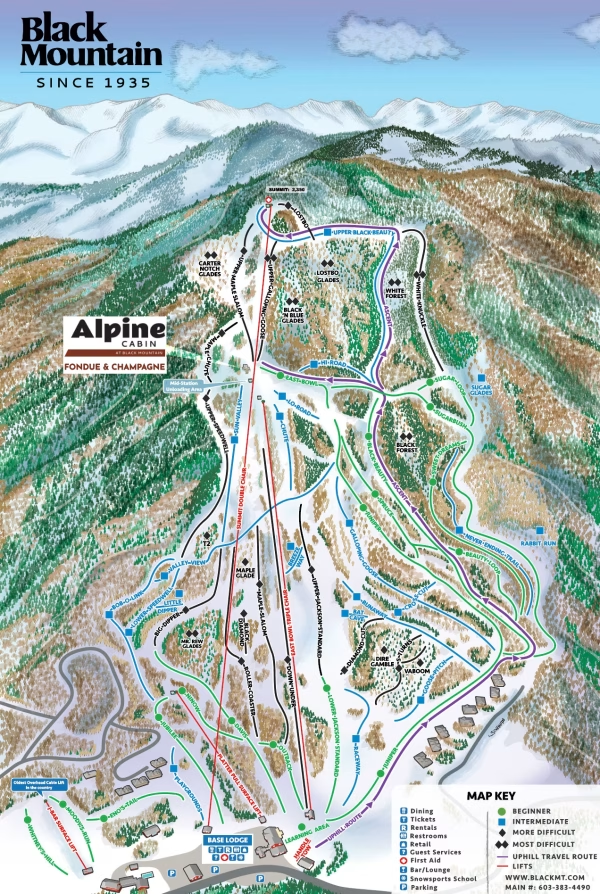
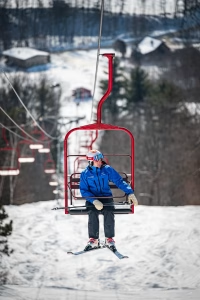
Black’s 1,100-foot vertical drop is not only humble on paper, but it also lacks steeps, chicanes, reverse camber, and ruggedness. The summit elevation tops out at a modest 2,350 feet, and there are a tight 140 acres covering 45 on piste trails and 15 gladed woods. Two slow chairs, a Summit Double and an East Bowl Triple terminate at the summit and the half-way point respectively.
The trail map looks easy, but on the mountain it’s more difficult to move around as everything comes up so fast and the connectors are so short. While there are 45 listed trails, that’s misleading, as many are just short little headwalls or chutes. As a result, you can’t go to Black Mountain for the gnar, there isn’t any. So, Erik Mogensen gave everyone a new reason to come to Black: you come to rage madly.
Erik Mogensen has completely transformed the idiom at Black; what was once ground zero for groomers and grommets has now become Party Central. “Jaspen” they call it, playing off Aspen’s cache and Jackson’s location, and the imprimatur is simple: since we don’t have terrain, we’ll make it up with glamour and glitz. So, enter “the A.C.” upon the scene – the Alpine Cabin: less a halfway-house and more a walk-in shack in which to order champagne and fondue, and then go outside and sun yourself at tables and deck chairs.
Champagne, fondue, and preening at the Alpine Cabin: lather, rinse, repeat. That’s Black Mountain now.
The A.C. has become so popular Black Mountain has become one of the top sellers of Veuve Clicquot in the United States. Seriously! Little Jackson, New Hampshire punching far above its weight.
Still, never-ending bubbly still doesn’t solve the bigger issue of being less than a 30-minute drive from Attitash and Wildcat. Or, more broadly, when you’re also competing with Cannon, Waterville, and anything just over the border in Vermont. Expert skiers need a completely different reason to come to Black because they’ll get bored easily. You can ski Black in a half a day. It’s like that municipal golf course where you play it in a scramble once a year, and drink a lot of beer…or in this case moderately-priced, non-vintage champagne.
Quality of Snow/Grooming – 9
Variety of Terrain – 7.5
Lifts – 9.00
Snow coverage – 9.25
Natural Setting – 8.75
Kid/Family Friendly – 9.
Character – 9.25
Challenge – 8
Dining on Mountain/Base Lodge – 8.25
Value – 9.25
Overall – 8.68

For New Hampshire: Attitash, The Balsams, Bretton Woods, Black Mountain, Cannon, Cranmore, Dartmouth, Gunstock, Loon, Pat’s Peak, Sunapee, Waterville Valley, Wildcat
For Vermont: Jay Peak, Bolton Valley, Middlebury, Killington, Mad River Glen, Magic Mountain, Mt. Snow, Okemo, Smuggler’s Notch, Stowe, Stratton, Sugarbush/Sugarbush North]
Other articles in this series:
PART 1 – WATERVILLE VALLEY
PART 2 – MAGIC MOUNTAIN
PART 3 – SMUGGLERS’ NOTCH
PART 4 – ATTITASH
PART 5 – MOUNT SNOW
PART 6 – CANNON MOUNTAIN
PART 7 – STRATTON MOUNTAIN
PART 8 – MOUNT SUNAPEE
PART 9 – LOON MOUNTAIN
PART 10 – JAY PEAK
PART 11 – PATS PEAK
PART 12 – GUNSTOCK MOUNTAIN
PART 13 – SUGARBUSH
PART 14 – CRANMORE MOUNTAIN
PART 16 – BRETTON WOODS
PART 17 – MIDDLEBURY SNOWBOWL
PART 18 – BOLTON VALLEY