

BLUNDELLSANDS, LIVERPOOL, ENGLAND – It was somewhere along the front nine of the West Lancashire Golf Club after the blustering 25-mile per hour gusts turned from directly in my face to a ferocious crosswind when I broke into the widest smile of the week. Once again, I had returned to my beloved northwest coast of England for another four rounds of golf amidst the seaside sandy dunes, and once again I felt as though it was my own Open Championship. Just give me a tolerable companion, a stalwart caddie, and some wind a la Shakespeare’s King Lear. After all – Nea rain, nae wind, nae golf! And as hometown heroes the Beatles might sing, if the sun don’t come, I’ll get a tan out golfing in the English rain.
That’s the attitude you need and will benefit from most on a trip to the UK for golf in the game’s birthplace. I come here seeking Open Championship conditions and to my inestimable delight, I get them every time.
With the right kind of eyes and attitude, you’ll have your own Open Championship too, and if you love links golf, prepare to have all your expectations absolutely shattered and to smile so wide, you’ll think you’ll pull a face muscle. England is the golf of all your most vivid nighttime dreams, and the West Lancashire Golf Club has been – for well over a century – rightfully called “the truest links in Britain” by both fabled authors and preeminent golf architects.
But you don’t have to take just Bernard Darwin or Donald Steel’s word for it. When news leaked that I was headed for the northwest of England and its ancient and storied golf coast, suddenly everyone came out of the woodwork with itinerary suggestions. I actually kept score; I asked golfers – “What’s your favorite course up there?” And here were the results:
A fistful of PGA Tour players – The West Lancashire Golf Club
A gaggle of Korn Ferry Tour players – West Lancs
Several professional caddies – West Lancs
Industry blokes from both sides of the pond – West Lancs
It wasn’t just a pattern; it was actually unanimous save two – a single golfer picked Hillside, and that’s because he won an Amateur Championship there, and another golfer picked Birkdale because he won an Open Championship there. Everyone else was wide-eyed with wonder and energetically eager in their reminiscences of West Lancashire.

Happily, even with all those lofty antecedents, West Lancs exceeds even the mightiest expectations. My unscientific poll had deemed it a downright imperative, and now I do as well: a must play and a bucket list course. West Lancashire is a thrilling links from opening tee shot to final approach, and every stroke in between is an adventure. Pros and amateurs alike, revere it for a solid reason: it makes perfect proving and practice ground for any tournament, from Open Championship to club championship and every level between. The wind whipping sideways allows them the chance to practice hold shots and hitting fairways in a maelstrom. (Indeed, West Lancs may see the ferocious winds of any of the Great Eight links courses of the Northwest, especially when storms blow in off the Mersey.) Better still, with greenside hollows, hummocks and grassy trenches guarding greens, they’ll hit every greenside recovery shot over the course of 18 holes. And in benign conditions, with reachable par-5s, reasonably wide fairways, and countless options around the greens, the best players are always looking to go low.
Still West Lancs is full of surprises. For openers forget the yardage book, the wind makes a mockery of the numbers; you’ll hit 170 yard 9-irons and 150 yard 3-woods and everything in between over the course of the day. Moreover, length is not an issue. In a crosswind, the longer you are, the further off line, your ball can sail, and that brings lost balls or unplayable lies into play. Penalty strokes are a mistake you can ill afford at West Lancs. You must march forward, not back.
Founded in 1875, West Lancs was the first among the eight great northwest clubs predating even Royal Lytham and Hoylake – and is one of the ten oldest clubs in England. In 1885 West Lancashire Golf Club joined 24 other clubs in paying for the purchase of the Amateur Championship trophy, and the names of those 25 clubs grace the trophy along with the names of the champions.
ON THE COURSE
Although the club is 152 years young, the links we play today was born in the late 1950s and early 1960s, a creation of golf architect C.K. Cotton. After World War II there was significant military damage to not just West Lancashire, but many of the great Northwest links. It was not an uncommon problem. Tanks rumbled all over the sand dunes, planes were landing and taking off constantly, and military personnel were given the run of club facilities. At Wallasey, for example, the fairways wind between the massive the damage done by German artillery shells. And at Formby, naval officers famously (or perhaps infamously?) took the club’s unofficial mascot to the Balle of the Norvik, a stuffed hippopotamus head named “Horace.” Many other clubs were also multi-purposed, (or in some cases sacrificed altogether).
“The modern West Lancs is an amalgam of the inland side of the former 27-hole facility that spanned both sides of the railway,” stated preeminent golf architect Tom Mackenzie, himself a veteran of renovating several Open Championship venues as well as myriad U.K. links. “There were two courses before – an 18-hole course for the men and a nine-hole course for the women.”
According to an Historical Research Report and Course Development Timeline prepared by Mackenzie’s architectural firm, Mackenzie and Ebert:
“This new design incorporated some of the fairways from the Ladies’ course and three holes from the Gentlemen’s course. The design emphasized elevated tees offering excellent views of the river and estuary. Significant care was taken to ensure no two short holes ran in the same direction. The course was laid out on approximately 200 acres, forming two loops of 9 holes, with the 9th and 18th greens positioned in front of the clubhouse. The opening of this new course brought an end to nearly 40 years of play on the previous layout, replacing it with a modern, cohesive course entirely on the river side of the railway, eliminating the need for footbridge access.”
Another, more unintentionally humorous memo appears shortly thereafter: in 1964, “Various improvements were made to the course, including alterations to the 10th hole to prevent balls from being hit into nearby properties.” There is also a notation particularly emphasizing that all four par threes run to different points of the compass and should have widely varying wind direction and velocity.
Two other architects have played important roles in West Lancs’s history. In the 1970s Fred Hawtree advised the club on critical landfilling work, preserving and protecting the precious sand dunes while also building them up higher. A long and pointed correspondence passed between the club and Hawtree, the latter believing the project doomed to fail. Happily, Hawtree’s fears were misplaced, and everyone in golf now regards the work as a smashing success in every regard – aesthetically, strategically, and drainage wise.
Then Donald Steel came in to improve everything from greenside defenses to bunkering to internal green contours – even new walking paths between greens and tees and from tees to the fairways. As the Historical Record recounts:
“Steel surveyed the course, leading to significant improvements. The club decided to implement all his recommendations, and the project took two years to complete….These improvements solidified West Lancashire Golf Club’s reputation as a high-quality venue capable of hosting championship events. The enhancements made under Donald Steel’s guidance ensured that the course remained challenging and enjoyable for players, aligning with the club’s historical standards and prestige.”
[Editor’s Note: A word about the scorecard: West Lancs has an unusual feature. The fifth hole changes par depending on what tee you play. The black tees and white tees – the tips and the medal play tees – play the hole as a par-5 and the course as par 72. But the gold tees, (used for visitors, seniors, and golfers that cannot hit a long carry), and for all other sets, the hole plays a long par-4. For the purposes of this article, we will discuss the hole as a par-5 played from either the championship tees (black) or medal tees (white).]

Stepping onto the first tee to lash the opening drive into the knee of the dog-leg, wind flapping your pant legs mercilessly, feels downright adventurous. A medium length par-4, the first is not overly taxing – bunkers at the three o’clock and nine o’clock positions bracket the green, while a third guards short right. No tricks to open the round, just solidly executed golf shots.
The strategy ratchets up another level at the second. Straight as a ramrod, this narrow par-5 features two center-line bunkers off the tee positioned right where you’d want your drive to land. They beckon like a sassy harlot at the end of the bar bawdily winking at you, but flirt with them, and they will hurt you. Typical of the deep, sod-faced riveted bunkers you find in the UK, they frequently dole out terrible lies where the unlucky golfer occasionally must play out sideways instead of towards the hole, often with a awkward and ungainly stance. Anything right off the tee and in the high rough will result in a completely blind approach over a No Man’s Land of towering shaggy dunes.
The fairway continues, a rumble strip between a sea of heaving dunes, past two more centerline bunkers placed to harass those that eschew trying to hit the green two, before terminating at a green the back portion of which is partly concealed by the huge greenside mound. Five o’clock and seven o’clock bunkers guard the entrance, but there is plenty of room deep.
“That’s one of the themes at West Lancs,” Mackenzie explained. “On several holes, even par-3s, part of the green is obscured. It’s one of the most enjoyable charms of authentic links golf.”
Short, but dangerous, the second is the template for all four of the par-5s at West Lancs. The temptation is there to go for an eagle, but the damage to your scorecard increases exponentially should you miss the green and find yourself bunkered, facing a ghastly, scrubby lie, or playing from a deep grassy swale and begging for a par.
“All four of the par-5s are like that – so reachable in two, but so perilous should you miss; there are bunkers in play on every shot on the par-5s here.” explains local golfer P.J. Flynn, an Artisan Member of the club: that is a separate group and membership away from the main club of 28 active members who work around 6 to 10 hours a month on the course to assisting with maintenance and conditioning in exchange for limited tee time privileges. They even get to work tournaments. Flynn is a near scratch golfer and a veteran of the myriad club tournaments and league matches there and can recall nearly five decades of the club’s events.
The third green complex introduces one of the West Lancs’ most enduring and endearing quirks – long, grassy trenches guarding the greens. Fear not: you can use the putter, though your distance lag putting must be sharp as the greens have both macro and micromovement. The first of the four par-3s, the green is set in a little dell, lower than the surrounding terrain, so the winds swirl insidiously. The grassy trench guards the left side while riveted bunkers guard short and right.
“The trench features like left of the third green are from when Donald Steel advised there in the 1980s and ‘90s,” Mackenzie noted. “They not only provide greenside challenge to the design, they’re also true to the links golf experience as the ground game is not only highlighted, but encouraged.”

Like all truly great links courses, West Lancs demands short game creativity, versatility, precision, and flair. Indeed, the two most atmospheric moments at West Lancs are 1) holding tee shots against the crosswind and 2) solving the Sunday Times crossword-puzzle-like intricacies of the West Lancs green complexes.
After four holes playing along the western edge of the course, the routing turns back towards the clubhouse at the short par-5 fifth, and the crosswind reverses itself, this time blowing in from a right-handed golfer’s right side. Like the preceding par-5, it is short on paper – seemingly just a drive and a mid-iron for long hitters – but three bunkers threaten the tee shot and an additional five guard the green. Those seeking to hedge their bets against going in one of the three greenside bunkers on the left risk landing in either the much deeper single pot bunker or amidst the rugged hummocks and grassy swales on the right.
“The fifth green is one of my favorites on the course,” Mackenzie states enthusiastically. “It’s such a classic with all its rumples, folds, and little shelves. It’s a thing of beauty and the perfect way to end a par-5 since it’s really several small greens in one with all those little sections.”
Exactly, difficult to hit either way: tough to hold with a long iron or a wood, yet with enough undulation to require laser precision even from a wedge.
The seventh hole presents a conundrum; 90-degree dog-legs are not supposed to work. But with no trees, a pulpit tee box, one hell of a Line of Charm, and a bit of wind, this par-4 becomes a fascinating par-3.5. Two cavernous bunkers guard the knee of the dog-leg, and the direct line carries over a desolate, tumultuous wasteland of shaggy mounds, knee-length marram grass, another deep bunker, and a minefield of uneven lies. And that’s if you find your ball. Interestingly, the longest hole-in-one in the British Isles was recorded here.
“It measures at over 350 yards, but as the crow flies, it’s only about 270,” Flynn explains. “Take the dogleg out, and if the wind helps behind, it’s drivable. I’ve done it a handful of times.”
Yes, but the penalty for missing can be severe and result in a two-shot swing or worse should you become bunkered or forced to play out sideways from a horrid lie in the rough. It’s an exciting swing hole in either medal or match play.
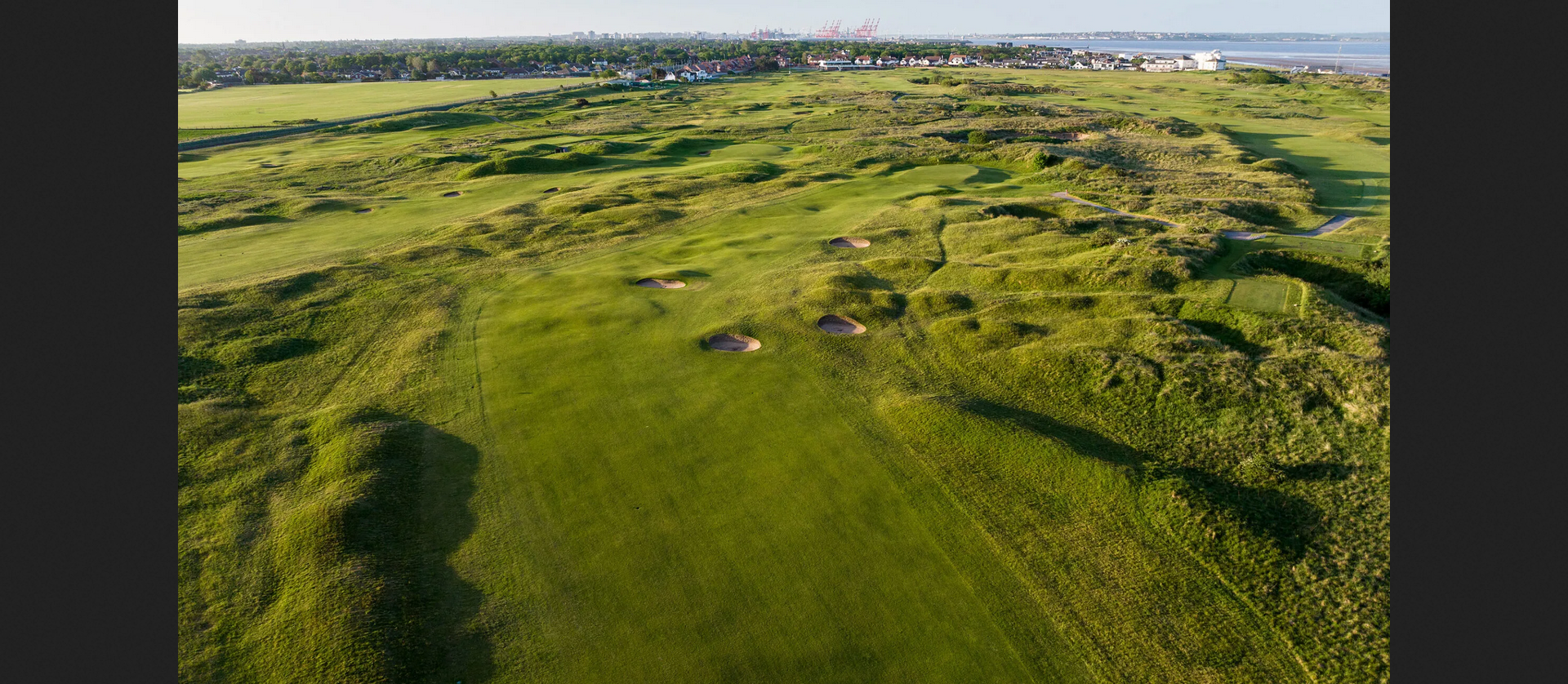
Two strong par-4s close the front nine. The tee shot at the eighth must thread between two massive dunes and draw slightly to finish on the right center of the fairway and the best angle to most pin positions, but the prevailing crosswind should help. While only one bunker guards the green anything right falls off into the grassy depression leaving a testy up-and-down. A depression crosses the ninth fairway about 200 yards out, acting as a speed slot for drives fortunate enough to catch it, giving the golfer anywhere from an extra 30-60 yards off the tee. Again, a single bunker guards the right, while the left and back slope away severely.
Take a nip of the most excellent complimentary airplane bottle of West Lancashire Golf Club scotch the club provides each player as a gift before tackling the back nine, some of the finest you’ll ever taste. It’s a most welcome bonus to an unforgettable day at the club. You’ll need it to propel yourself into a battle with the atmospheric back nine.
10 and 11 should be considered birdie ops despite being peppered with bunkers everywhere, including the middle of the fairway. Though only one bunker guards the three o’clock position of the 10th green, the rest of the putting surface slopes away on all sides. Straight as a pool cue and following the railway line, seven fairway bunkers pepper the 11th fairway randomly. A tall stand of trees lurks behind the green at the base of a gargantuan hill. Storms often roll in over them from off the Mersey, an ominous sign for those venturing further out on to the back nine.
If nothing else, the par-3 12th is unforgettable. Easily the most intimidating short hole on the course, the putting surface sits so deeply amid a heaving sea of dunes, you might ask yourself, “Where’s the green??!!” The yardage book says, “So long as you carry the bunkers, you have a chance of making a three,” but that’s a substantial “so long as,” because it seems like there is nowhere to miss, even though you see the flag.
But the view from the tee box is an insidious and clever optical illusion. Not only is there a large circular upper bowl section, a lower shelf sits far beneath its larger sister, connected by a slender rampway. I have seen a green like it before, at Tot Hill Farm in North Carolina, designed by golf architect Mike Strantz, who also designed the aforementioned Tobacco Road. Nearly identical actually, a small circle of green then ascends a steep narrow neck to a much larger oval.
“The 12th green is fascinating. Once again, you don’t get a full view of the green, even on a par-3 – a classic links feature,” beamed Tom Mackenzie. “It’s such a huge drop down that slope to the lower tier, we’re not entirely sure that the front left section was originally intended to be green, but the strategy it embodies is definitely part of the rich tapestry of links golf.”
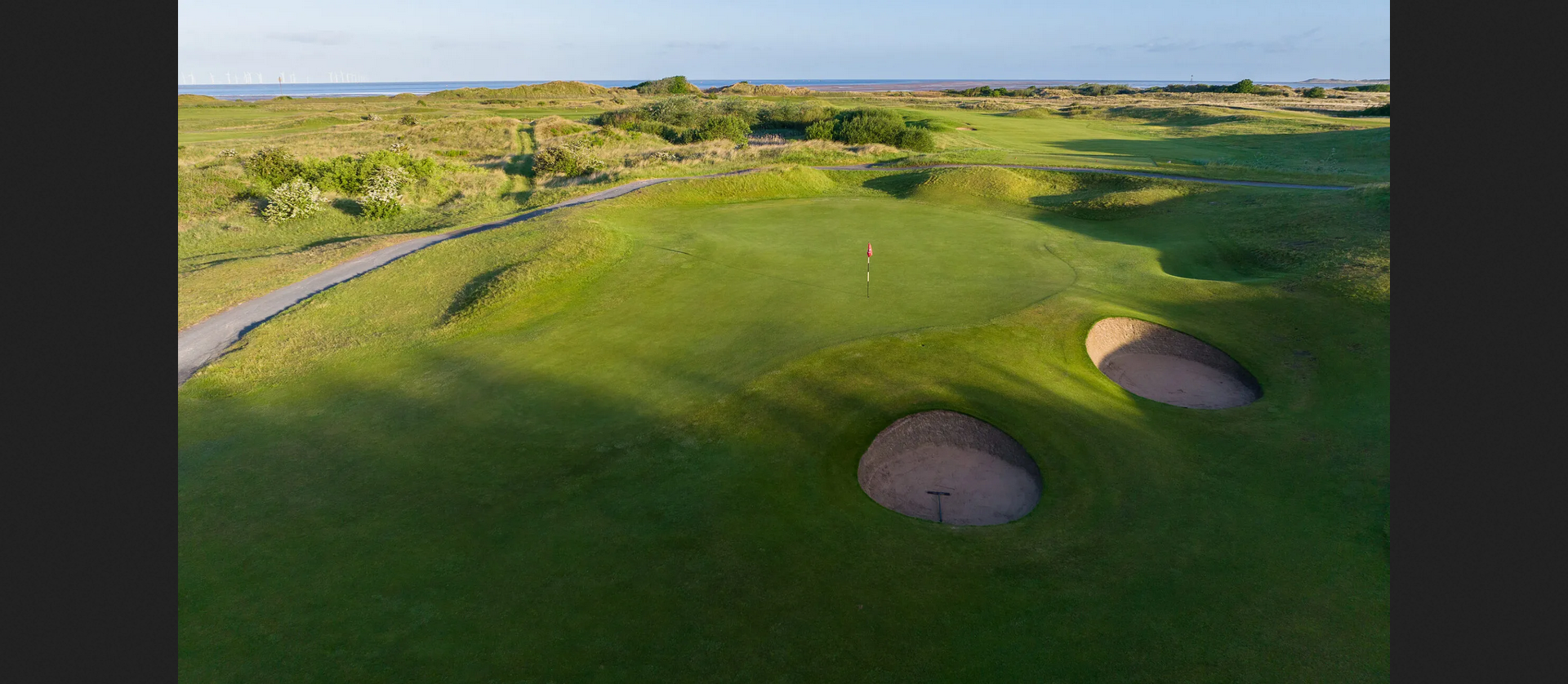
The course throws down the gauntlet starting at the 14th, so get ready for a stern examination at the finish. In fact, it’s likely that 14 and 15 are the toughest back-to-back holes on the course. The tee shot at 14 requires a forced carry over fescue covered mounds, where anything right off the tee or short risks either a lost ball among the knee length rough and heaving dunes, or at best a pitch back to the fairway and a long shot still remaining into the treacherously guarded green. There are no bunkers on the approach, but with runoffs of as much as 40 yards short and left, the green needs no bunkers. The trees swallow approaches that flair right. Finally, the entire green sits offset obliquely from the fairway, and is partially obscured if the drive doesn’t carry between 250 and 300 yards.
“It’s the number one handicap hole for good reason,” Flynn warned. It’s 100% justified. [A] long dogleg right, tree-lined to right too, make sure you play the hole at its full length, rather than attempting to chew off a piece of the corner.” Sound advice.
15, though short, can be catch long hitters unaware as the prevail may send pulled or hooked drives over the railway line and out of bounds. A bunker guards the left front, while the right runs off into a grassy swale or a second deeper bunker.
“You have to be careful at 15,” admits Flynn. “With the OB and the railway on the left and the trees on the right, it’s a difficult drive at a critical point in the round. 15 catches a lot of people.”
The last of West Lancashire’s “par-5, par-3 combos” appears at 16 and 17. The fairway at the final par-5 slithers serpentinely between five bunkers before ending at a green shaped like an overturned tea cup, sloping off in every direction.
The home hole is a bit of an anomaly at a links course as the club’s irrigation pond lurks right of the fairway, waiting to catch goofy slices or long bombs that misfire. Bunkers on the left of the fairway b ring the pond even more into play as golfers fearing one hazard, suddenly point themselves directly towards a worse one.
“The expansion of the irrigation pond adds menace to the tee shot, especially for the expert player,” Mackenzie explained. “And into a right to left gale you have to be brave to start it out over the pond. But that’s exactly what you have to do. The pond’s presence ramps up the challenge.”
But don’t think that once you’ve carded your last “Fairway hit” of the day that you’re home free. The final green is fiendishly clever in its intricacy, well protected by bunkers and roll-offs on the sides and back and with enough internal contour to defend par.
THE ROSE AT SUNSET
“You have to drive the ball well, straight is more important than long,” Mackenzie summarized. “You have to think your way around; there is no simple formula for success. And it’s an Authentic links, so you must be prepared to think like a links golfer.”
And that was the most thrilling part of the day. Bouncing bump-and-run shots off greenside mounds with just the right carom to feed the ball to the hole. Belting out head-high line drives with my irons to cheat the wind. Putting from 65 yards off the green and leaving it stone dead to save a terrific up-and-down. Not only will you hit every club in your bag, you could need any and every club in your bag even for just one shot.
“At 12, I’ve hit everything from 58-degree wedge to driver on that 170-yard hole. Even the slightest of winds on the par-3s is easily four a club difference.,” Flynn declared. “The prevail is usually around 18 mph on a good day, and being so exposed on the coast, West Lancs plays differently with every change in wind direction.”
If there is a supposed shortcoming at West Lancs, some purists wish that some of the holes had been routed over some of the more larger dunes – and indeed, that’s always thrilling golf; we all love a good Alps hole. But as that same critic also wrote, “the course feels so natural, it’s more a rugged challenge against nature itself than against the golf course. And the conditioning was second to none.”
The course was so electrifyingly fun, I had to play it again, of course. Coming down number 10 watching a bar sinister rapidly approach, frowning darkly over the Blundellsands, storm clouds brewing like a witch’s cauldron. Still, I soldiered on. Come winds, blow. Rage, and crack your cheeks. I’ll just play it off the edge of the fairway and let you bluster it right back into the middle of the fairway.
This is golf in its purest form, swashbuckling excitement on the edge of the world. But that’s what you come here for in the first place. The pulse of the golf zeitgeist can always be found in the northwest coast of England.