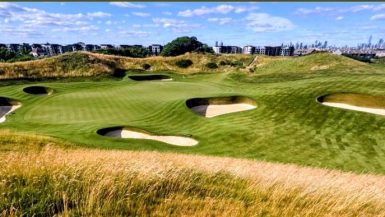


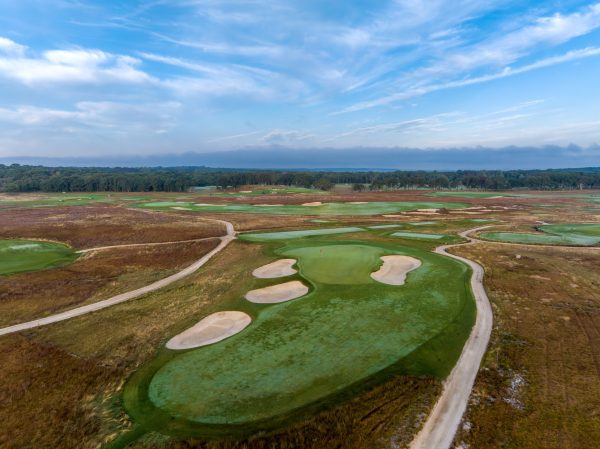

in the Southampton, N.Y. on Monday, Sept. 15, 2025. (Copyright USGA/John Mummert)
SOUTHAMPTON, NY – Nowhere will Shinnecock Hills reveal its slavering jaws as a U.S. Open venue more than at its formidable par-3s.
For mere mortal golfers, the par-3s can often be a welcome refuge from the course. Occasionally – not often, but occasionally – the shortest golf holes are the deadliest: like the 12th at Augusta National, the 17th at Pebble Beach, or the Postage Stamp at Royal Troon. But at Shinnecock, the par-3s are waiting to sink your scorecard and tumble you down the leaderboard like the earth opened beneath you.
Shrouded in controversy, with success and failure balanced on a knife edge, these are the holes at Shinnecock that make golfers’ stomachs ache with consternation. “What appalling disaster may befall me?” they ask, knowing full well the gut-wrenching history of the past. The 2004 disaster where four, five, and even six putts were recorded multiple times, before the seventh green had to be watered between groups playing the hole…on Championship Sunday no less.
That’s on Tom Meeks of the USGA. He was resident comedian…err…he set up the golf course that year.
But then they didn’t get it right again in 2018, and the 11th green saw hockey games break out like the Islanders and Rangers were playing instead of Phil Mickelson and Brooks Koepka. Mickelson refused to speak to journalists for the rest of the week. Some journalists, in turn, wrote that eh should have been DQ’d for poor sportsmanship.
Irrespective of shenanigans with watering and rolling and press baiting, the holes are tough enough themselves without getting “tricked up” as writer Marino Parascenzo called the U.S. Open set up. And not only are they difficult, they are strategic marvels featuring gorgeous contours and bunkering. Better still, not one of them uses water as a hazard, proving that Golden Age golf principles still shine through in the modern age. And without question they will knock more than a few golfers from the top of the leaderboard.
Hole 2 “Plateau”, 252 yards
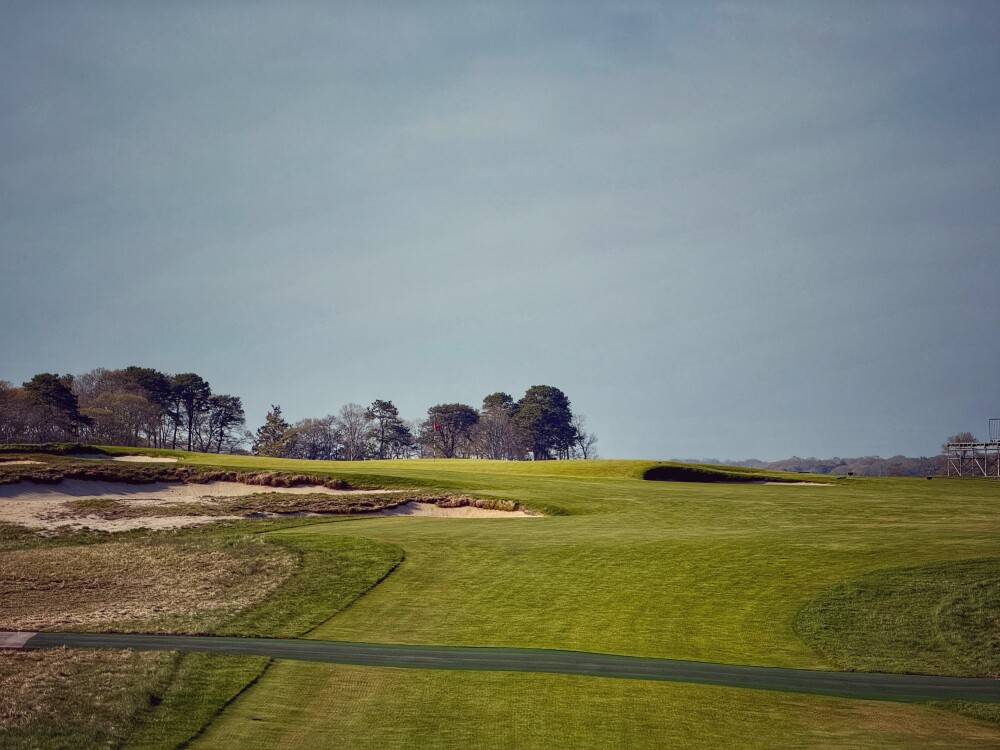
The longest par 3 on the course depending on hole location, it can play anywhere from around 200 yards to over 250, forcing players to hit anything from a long iron to a fairway wood. The green may be deep, but plateau greens feature significant swales and sections. If you’re on the wrong sections, you’re lagging from 35-45 feet over a severely sloped and treacherously angled ascent or descent to the next level.
While most golfers will choose the aerial route, for some hole locations, the entrance to the putting surface is open, so one bounce and run is an option the restoration Hanse left for the players. Yes, we even may see some ground game! Especially since the wind swirls at this little corner of the course, and judging it is confusing. Thet hole may well play over par for the week. Have fun watching walks of shame as balls roll back to the players’ feet. But then again, watch also for excellent contour feeding to the hole from players who gauge the distance control and runout perfectly.
Hole 7 “Redan”, 190 yards
One of the most famous and infamous par 3s in American golf. The Redan is the most copied hole in the entire world, with the green angled diagonally from front right to back left and featuring a ginormous kickplate to feed the golf ball left and back. Players are required one way or the other to use the contours rather than firing at the flag. Allow the natural slope of the terrain to feed the ball to the hole.
But at true Redans, the putting surface slopes away from the tee, always bringing trouble behind the green into play, in the case of Shinnecock, a steep slope and ankle-deep fescue. Any miss long or right leaves delicate, awkward pitches played down the slope, while short is buried in the deep Redan bunker. Shorter than most Redans – they usually cover between 175-210 yards – the green contours at Shinnecock’s seventh are so severe, the lack of distance does not lessen the holes defenses significantly.
Hole 11 “Hill Head,” – 157 yards
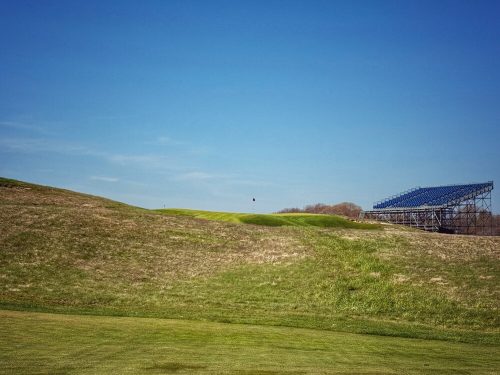
Thought the shortest hole on the golf course, what 11 lacks in length it makes up for in a steep, ascent, a shallow green, and a dramatic left to right tilt. Called a “Short” hole in the golf architecture vernacular, the hole nonetheless contains some of the golf course’s most curvaceous green contours.
Depth perception is the biggest problem at 11, as the shot plays two or three clubs uphill under windless conditions. But with no depth perception, just the lonely flag fluttering against the blue sky, players will have to visualize the shot internally, and totally trust the swing with regard to both accuracy and distance control. Once again William Flynn, the original architect used optical illusions and deception as defenses, and nerve-wracking ones at that.
When the wind blows hard in this little corner, the golfers will certainly feel the same way they do at 12 at Augusta, where the winds tend to gust at random moments as well as swirl. A wrong club selection here can be the difference between birdie and double bogey.
Hole 17 “Eden”, 176 yards
The 17th hole, but also the 71st hole, and by then the pressure on a golfer is white hot. The U.S. Open is within reach. Just three good swings from the tee and fairway and a couple of putts, and you could go home with the trophy! And besides the mighty 18th, only an “Eden” hole stands between you and victory, but Eden holes are notoriously tricky, and 71st holes at major championships are crucibles no matter how short or long.
Here at Shinnecock, the 17th green sits at an angle to the prevailing crosswind, so any shot off line will billow further off line. Hold shots into the crosswind are tricky to judge if you haven’t been hitting them all day. Trouble awaits in the form of both bunkers and sloped runoffs.
And for those of you wondering how mere mortals would do? A convention of state judges taking continuing education classes, all rank amateurs, played Shinnecock after the renovation – from the regulation tees, nowhere near the tips – and the scores were astronomical, especially at the par-3s.
“On the second hole, we gave this one guy his eighth putt, and he was still seven feet away,” laughed one competitor. “And on number seven, we gave him a seventy-foot putt for a 10!”