


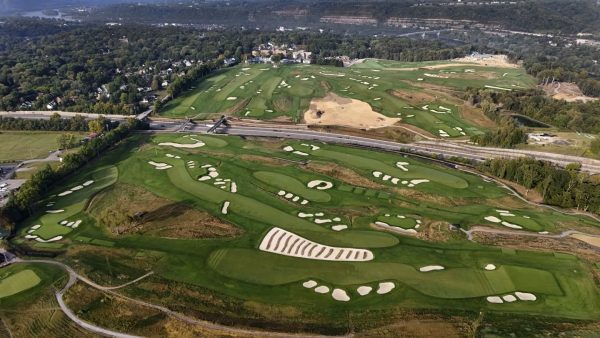

Picture yourself for a moment lying in bed the night before you tee off in the U.S. Open…only it’s the U.S. Open at Oakmont.
The National Open is routinely played at only the finest and most difficult golf courses in the country. “Golf’s Toughest Test” is the semi-official moniker, and the USGA means it. Historians may quibble as to the exact genesis of the inception of that imprimatur, but only Winged Foot brings as much cloak and dagger terror to a major championship as Oakmont, America’s great grassy guillotine of a golf course.
Oakmont – where dreams of golf immortals not named Hogan and Nicklaus go to die.
Now factor in the night before jitters. Or perhaps, far worse, that lonely, two o’clock in the morning emptiness of the soul when all the world is asleep except you…and despite all the excitement, you know something isn’t quite right. Maybe you haven’t quite worked out that hitch in your swing and tee shots are hanging just a bit too far right for these criminally narrow fairways. Or maybe the distance control is off on your lag putting, and with the insidious internal curves on these greens, you’re going to be visiting three-putt city for two days. Or maybe your one groove off on your wedges and instead of three footers you’re finding the ball went sideways into one of Oakmont’s myriad swales and you’re facing the most delicate of chips and begging for a four.
Do that even just a few times at Oakmont, and you’re leaving Pittsburgh on Friday evening with a trunk slam and a screech of tire.
The nightmares begin at the first tee, with out-of-bounds lining the entire right side of the fairway. One nervous or uncertain swing, and you’re starting your U.S. Open with a re-tee and a likely double. Worse still, a half-century ago in a playoff in the NCAA Finals, one player hit five balls off the first tee, each one of them into what were then the trees. He turned to his opponent and conceded the match. Caddies later found his first ball in bounds.
What follows is a non-stop barrage of difficult strategic questions and infinitesimal calculations amidst an unexploded minefield of double bogeys. Fairways are averaging a mere 18 yards wide. Several of the tee shots are blind. The six inch long rough had to be cut with walking mowers today as weeks of non-stop rain have turned the normally lush and ling fairways into the jungles of the Serengeti. Balls disappear from view, long grass turns the shaft, the face closes at impact and – WHOOSH – out squirts a head-high, low left hook. Or worse a flub. And a drainage ditch winds its way drunkenly around the course, lining the edge of some fairways, while crossing others right in the desired landing areas.
Not only are the green speeds going to be the fastest ever recorded for a major championship, Oakmont’s greens are also the most curvaceous. They are also canted in random directions – some, like the first and the sixth slope away from the fairway. Others, such as twelve and fifteen are sharply tilted to one side or the other.
Relentless. Unfogiving. Indominable. That’s Oakmont.
That’s what the man who seeks to conquer her must be.
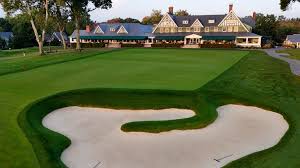
“You go to a place like this, they don’t need to set it up any differently or trick it up or do anything for it to challenge both the physical and mental part of our game. Oakmont is plenty challenging in both of those aspects,” noted two time major championship winner Justin Thomas, here in Pittsburgh to attempt to bag his first U.S. Open. “I just think it requires patience and discipline. If you just get lazy, like on any drive, any wedge shot, any chip, any putt, you can kind of look stupid pretty fast, especially at a place like this,” he concluded.
That’s what Oakmont designer Henry Fownes wanted. A steel magnate, he wanted a tempered steel-tough course for the Steel City, reflecting the hard-nosed,iron-willed denizens. Now for its record 10th U.S Open – the first was in 1927 won by Tommy Armour – for its record 10th U.S. Open, the course will tip out at 7,481 yards. That’s nowhere near the longest major course in history (Kiawah Island’s bloated 7,876 yards in 2021), but who needs brutish yardage when there are 175 insidiously placed bunkers and the rough is six inches long, thick-bladed, and lush from unending weeks of rain.
“It just puts an emphasis on hitting the fairway and hitting greens. If you’re a premier ball striker, you’ll be licking your chops…You’re legit in the fairway, in the first cut, or it’s pretty hard to be in the bunker and have an open shot to the green,” surmised Xander Schauffele, another two-time major winner, both from last season, the Open and the PGA. “It takes a serious amount of discipline to play away from pins and hit really good shots to safe targets, and that’s what it takes to play well at U.S. Opens.”
There are precious few moments at Oakmont where the cloak and dagger claustrophobia relents. Perhaps a mild break comes at the short par-4 second, but the Church Pews make their ominous appearance on holes three and four. Steer away from them and you’ll risk tumbling into the even more penal, deep bunkers benched into small hillocks on the opposite side of the fairway. One of those high-faced bunkers dealt Tiger Woods a critical double bogey in the final round in the 2007 U.S. Open when he lost by one shot to previously unheralded Angel Cabrera.
Eight and nine will test gargantuan length with a 301-yard par-3 and a 525-yard par-4. All the talk has been about eight essentially being a “par 3.5,” but the ninth was where Arnold Palmer let his lead begin to slip away in 1962, allowing rookie Jack Nicklaus to catch him with a birdie on 17 and then gut Palmer the next day in an 18-hole playoff. Palmer was greenside in two, but then duffed a chip, left another putt short, turning a birdie into four into a six and cutting his lead to just two when he could have turned four ahead.
Only a generational talent like Nicklaus could win a major as a rookie, let alone slay Palmer – the King! – in his own back yard. Perhaps Jack was too young to be intimidated by Oakmont.
“Even though I hadn’t had a lot of high finishes, I felt coming in that it was my tournament to win,” Nicklaus recalled years later, sitting for a USGA interview. Plus “Fat Jack” as he was known back then for his burly, football-esque build, hit the ball farther than any one on Tour back then. And that wasn’t just off the tee, it was through the bag…even with clubs we mere mortals can’t dream of hitting, like 2-woods and 1-irons. Jack was as indomitable as Tiger in his day, and Jack had a lot more immortals nipping at his heels than Tiger did.
The only hope the players have to finish under par is more rain, and that’s not uncommon for Oakmont, where summer thunderstorms rage across western PA. In 2016 Oakmont turned to Soakmont, allowing four players to finish under par, thought three of them were just 1-under. Dustin Johnson took home the trophy and medal with a 4-under 276. And people forget, (and Johnny Miller will never admit it), but the torrential rains all week in 1973 took all the teeth out of Oakmont on that Sunday. So if any of the 63 in the record books should have an asterisk near them for weather it’s Miller’s and also Jason Dufner’s at Oak Hill in 2013 (Which Your Author renamed Soak Hill.) Expect something similar this timer as well.
“I played with Jordan [Speith] and Jackson Koivun today, and Jordan and I were saying we were still shocked with how soft the fairways were,” Justin Thomas observed. “The greens still had a little bit of bounce to them. They weren’t firm by any means, but they were still taking a hop with wedges and short irons still.”
Yes, but the other side of that coin is that the rough gets thicker and longer.
“Jackson had a lie on 15 today that we were kind of thinking is it a 6-iron? Open up a 6, or could you hit 7?” Thomas explained. “He tried to hit 6-iron, and it looked like he could, and he hit it like four feet in front of him.”
There will be plenty of that this week.
With Oakment presenting the quintessential hardest test of the year, look for a strong, long Tonka-tough golfer to triumph, and that means defending champion Bryson DeChambeau. More tellingly, DeChambeau played a practice round a mere two weeks ago clowning around on YouTube and shot a breezy 70 on a windy day.
If anyone can absorb Oakmont’s unrelenting body blows for 72 holes its DeChambeau. Yes, perhaps even more than Scottie Scheffler, though Scottie, far more than a recently slumping Rory McIlroy, is likely to play the foil to DeChambeau.
And DeChambeau mentioned one other point in his favor: Oakmont is remarkably similar in strategy and tactics to Winged Foot. And he won there.
So strap yourselves in for a classic, old school U.S. Open. 280 (EVEN par) should win it for certain. Many are predicting an over par winner, but with some moveable tees, that should provide some birdies to balance things out.
Can Oakmont be tamed in the right conditions? Weith the right mindset, flawless execution, an iron will, and the perseverance to withstand 72 brutal holes can throw at you..
“It wasn’t designed to be fair. It was designed to be feared,” said DeChambeau in a YouTube review of the course. “This is the hardest this course has ever been.” And he later said it might be the hardest in the world.
But then again, that’s how it’s supposed to be. At a real U.S. Open, the course is the star. And you don’t win such an Open, that Open wins you. And that’s enough to keep any golfer awake all night long.