

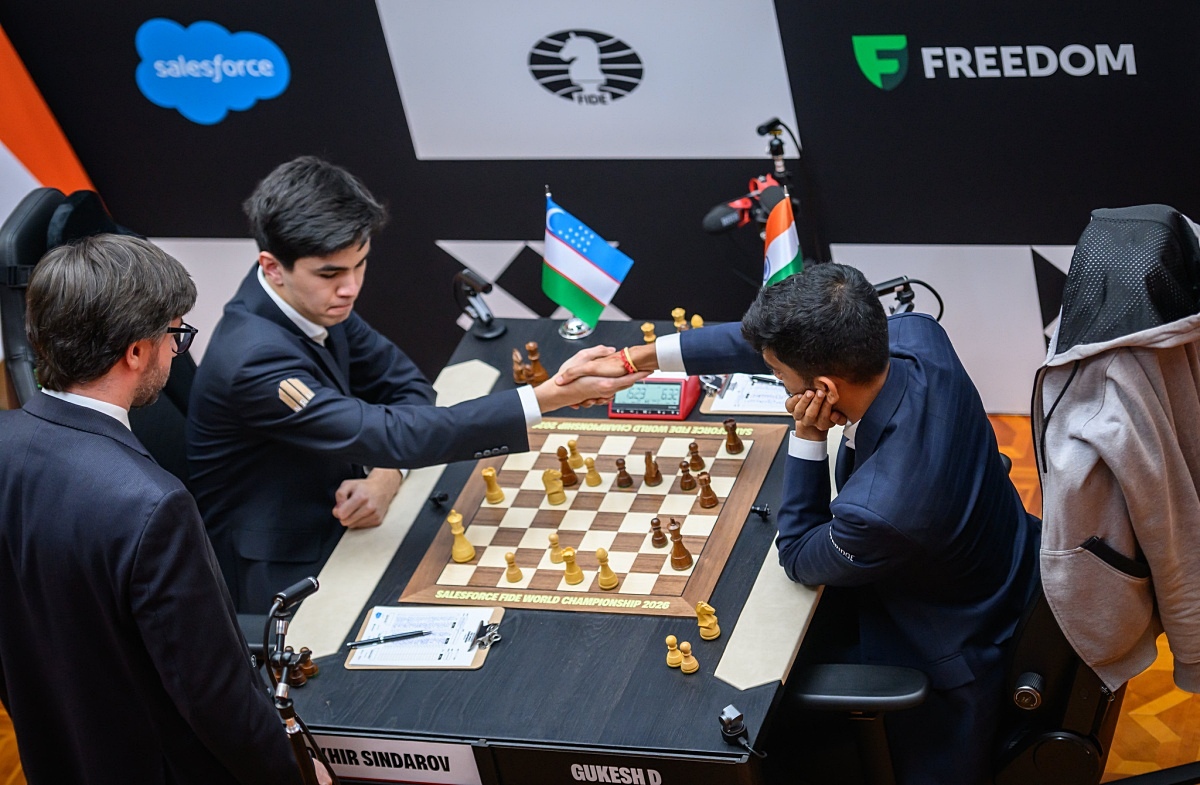
[Editor’s Note: As we got to press, Javokir Sindarov and Gukesh Dommeraju are tied 2-2 in the 2026 FIDE World Chess Championship.]
In 1993 the chess world crowned two world champions. FIDE, the Paris-born self-appointed official governing body of the sport, argued with its own competitors,reigning World Champion Garry Kasparov and challenger Nigel Short of England. Citing dissatisfaction with the prize fund, the location of the match, and rules governing the games, the pair broke away from FIDE and formed the Professional Chess Association., creating two rival governing bodies until reunification in 2006. In retaliation, FIDE stripped Kasparov of his official title and arranged a separate championship match between Anatoly Karpov and Jan Timman—two players Short had defeated in the Candidates cycle.
Is chess at a similar crossroads? Magnus Carlsen won five consecutive FIDE world championships between 2013 and 2020. But like Fischer before him, Carlsen walked away on top, leaving a huge crowd grasping for the brass ring, and no clear dominant figure emerging, similar to Tiger Woods’s unparalleled dominance in golf in the 2000s.
Now Magnus, bored with his dominance, is aggressively pushing randomizing the starting positions of the back rank pieces – again taking a cue from Fischer and his “Fischer Random” idea. As a result, chess is poised to become even more confusing in two ways: how to play the game in the first place, and who is the best player in the world in the second. It’s a potential bifurcation of the game.
Another bifurcation, and perhaps a welcome one, is Total Chess, the new pilot tournament format focusing on testing three different time controls, all of which are shorter than the classical chess time controls used in the FIDE World Championship and Candidates Tournament. Total Chess, which concluded two weeks ago combined 5 minute games, 15-minute games, and 45-minute games. Instead of a round robin, 24 players split into four groups of six. The winner of each got to play on the semi finals and finals in knockout form. The remaining 20 players – out of contenti0n for the top prizes and for bids to the Candidates and other events – were flighted into groups of four based on where they finished in their groups. In the knockout phase, four blitz games counted one point each, two rapid games counted four points each, and one fast classical game counted eight points.
Basically, a player could go 2-5, yet still win the match: lose all four classical and one rapid, but win one rapid and the fast classical and you win 12-8. But did the best player really win? Or was the best player the player who played best in the clutch? A crucial and important distinction, and one that can be argued both ways. Still 2-5 is a losing record…abd some players advanced with that exact line score.
So it’s a clumsy execution of a good idea in general. They need 32 players, not 24, and eight groups of four instead with the top twp from each group advancing to knockouts. They instead of seven KO games inequitably weighted. Play just two blitz, two rapid, and two 30-minute fast classicals. That would obviate the need for repeating semi-final matches to equalize switching colors.
Things are now further muddied with Carlsen being on the verge of finally – after 15 years on top – Carlsen is in danger of finally losing his World Number 1 ranking to Fabi Caruana. Carlsen, who begged, even bullied tor formats like this, completely spit the bit in Total Chess. Our once but not for long future GOAT played ten games in the group stage and scored an abysmal ZERO WINS-NINE DRAWS AND ONE LOSS!
He also lost to Witty Alien. Google it..or better yet, YouTube.
Ten games and Magnus had a negative score. Even under my system where the top 16 go to knockouts instead of four, Magnus would have missed out – he finished a lowly fifth in his group and played for 17th place.
And more damning, Fabi Caruana crept to within a single rating point of Carlsen, so Carlsen started skipping games in Total Chess.
First, this is a new world Championship format Magnus as been lobbying for, something less grueling than 120 minutes for 14 games and more diverse in skills. But Magnus, jealously guarding number one ranking, skipped games – once when the match was out of reach, so the games didn’t affect the outcome. But then again he did it again when behind, calculating that is he won the fast classical, results from rapid losses wouldn’t matter.
He made a mockery of the format he lobbied for. That’s not GOAT-like.
Not for nothing, but here’s something no one has touched on: not Hikaru, nor Gotham Chess, nor Fabi and his C-Squared podcast with Christian Chirila: if Magnus’s lawyer is half as good as he should be, he’d have an incentive clause in EVERY sponsorship deal that gives him a huge bonus for every year he remains ranked number one. I would, for sure, expect that.
Nevertheless, Magnus’s boredom may be bad for chess in general. And his business interests certainly are not always aligned with the game’s either.
Total Chess concluded with youngster Alireza Firouza of France defeating Anish Giri of the Netherlands for the title in an armageddon tiebreak. Not for nothing, and again, like soccer, in the event of a tie, we decide the world championship on the metaphoric equivalent of a penny toss…or a chip-off in golf. In the World Cup its penalty kicks, in chess its who runs out of time first or blunders their life dram in a time scramble. Too random.
Still, it was Magnus himself who once anointed Alireza as his potential successor, and even said that he was only interested in playing Alireza for the title in the future.
So cut to Geneva and defending world champion Gukesh Dommeraju of India is battling challenger Javokir Sindarov of Uzbekistan. Sindarov is ranked fourth in the world while Gukesh has plummeted to 29th. He’s had last place finishes in more than one event, and has won nothing of note in the two years since he won the FIDE world title from Ding Loren of China when Ding blundered a drawn endgame on the final day of the 2024 championship. Javokir came in as a heavy, heavy favorite.
Of course the score is 2-2 and Gukesh has been nigh flawless for four Kings pawn battles.
So here is the burning question: who is really the best chess player in the world? Is it the fastest? Is it the deepest, like Gukesh and Sindarov are showing thus far? Can Fabi or even Hikaru pass Magnus and seize the Number One ranking? And why does the winner of the FIDE world chess championship only have to defend his title one time against one opponent? In no other sport does the winner get an automatic bid to the finals and get a pass on an entire regular season and playoffs.
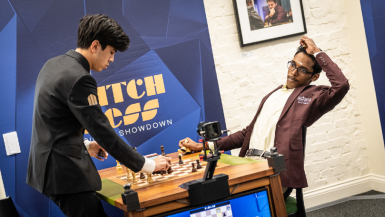
Magnus has a few things right. Classical chess at the highest level takes too long. And the automatic bid to the finals is a remnant of a Soviet-style compact to cement control. Total Chess is on the right track, it just has its weighting systems all kablooie. Blitz proved useless in almost every phase of the tournament. Finally, seven games a day for two days against the same payer was grueling. Another way – if they insist on two days of semis and finals and even quarters, would be one game of blitz, rapid, and fast classic each day, reversing the colors for the second day’s play. Additionally, Grandmaster and chess commentator Maurice Ashley has designed Clutch Chess, perhaps my favorite new format where won games increase in value as the tournament goes on, to as many as three points for a win. Only a month ago, Sindarov won the 2026 edition of the event, defeating a star-studded lineup of Caruana, Hikaru, and Pragg.
So who really is the best player in the world? Magnus’s bright and prominent star is finally fading, but so too may be FIDE’s two hour, 14-game, super-marathon, biennial slog. Who is the proper World Champion now? Gukesh may claim the title, but is he anywhere near the best player? 28 guys say no. What about Alireza, who just triumphed over a Murderer’s Row at Total Chess? Or Anish Giri, who lost Total Chess in an armageddon tiebreak? Or Caruana, still formidable? And Sindarov? If he wins, he can right fully claim it as he beat everyone in the Candidates handily. But is he better than a fading Magnus? Should Sindarov win, I think the chess world deserves to see that matchup.
Could we see it? Magnus likes money as much or more than he likes chess it seems, so maybe some rich bettors should fund the game. Either way, chess is the most exciting and cool it’s been in over a century. So, stay tuned.