


Royal Lytham & St. Anne’s Celebrating 100 Years of Open Championship Heritage
[Editor’s Note: While we record some more radio shows and prep for a glorious return to England for more from the northwest golf coast, Jay has this review of a century of professional major championship heritage at Royal Lytham. And St. Anne’s. Coming soon: Lytham’s archivist and historian Steven Reid joins Jay for a discussion and story of Lytham’s equally fabled history in the amateur game.]
It’s the Westminster Abbey of Golf: ancient and venerable, sublimely beautiful, yet ferocious and cunning. And next year Royal Lytham and St. Anne’s, one of the game’s most holy grounds, celebrates 100 years of both major championship history and Bobby Jones’s Open Championship victory there as an amateur.
The Open Championship has been contested 11 times at Lytham, and the en tore world hopes the R&A will return to Lytham soon and often for the Open, the de facto World Championship of Golf. Golf architect Martin Ebert has been stewarding the club through a master plan that saw recent changes to holes six, seven, and 11 to accommodate a new practice facility for the Open. But Lytham remains largely the same as when Harry Colt renovated George Low’s 1890 design in the 1930s.
Lytham tends to crown immortals, and the list of golf titans that have won there will lengthen so long as the golf course continues to present among the sternest of tests of both golf planning and execution on Planet Earth, particularly when it comes to bunkering. Here are the Open Championships contested at Lytham and some of their most dramatic moments.
1926 – BOBBY JONES

In one of golf history’s indelible mileposts, Bobby Jones won the Open Championship as an amateur, one of only three golfers to do so. It was his first of three Open Championship victories.
What was anticipated by the press and golf world alike as a battle between Walter Hagen and Jones, (competing against each other in the Open for only the second time since 1921 at St. Andrews, when neither won), never materialized after Hagen, who led after a round one 68, slowly percolated further and further down the scoreboard, leaving the battle to Jones and fellow American Al Watrous.
Jones trailed by two as the pair entered the vortex of the maelstrom – the final five par-4 holes at Lytham. Jones carded a brilliant 4-3-4-4-4 finish to win by two, including the shot of the tournament – a blind mashie-niblick from behind a sand dune and out of a rugged, ragged fairway bunker that finished on the green and inside Watrous’s approach. Al was so unnerved by the thunderous blow, he three-putted the 71st green effectively handing the Claret Jug to Jones.
No less a personage than John Hopkins, the venerable, indeed indispensable UK golf writer for the Times, called Jones’s shot one of the three greatest shots in golf history. (The other two, for those of you scoring at home, were Gene Sarazen’s 4-wood for double eagle in 15 at the 1935 Masters and Tom Watson’s chip-in at Pebble Beach’s 17th to edge Jack Nicklaus at the 1982 U.S. Open.)
Jones later won the U.S. Open that June at Scioto Country Club in Ohio. Only five other players have equaled that feat in 100 years: Tiger Woods in 2000, (U.S. Open at Pebble, Open at The Old Course at St. Andrews), Tom Watson in 1982 (U.S. Open at Pebble, Open at Troon), Lee Trevino in 1971, (U.S. Open at Merion, Open at Birkdale), Ben Hogan in 1953, (U.S. Open at Oakmont, Open at Carnoustie), and Gene Sarazen in 1932, (U.S. Open at Fresh Meadow, Open at Prince’s, a course sadly no longer used for the Open, but still stunning links and adjacent to Royal St. George’s.)
Jones went on to win his Grand Slam…err…”Impregnable Quadrilateral” in 1930, bagging the Open Championship at Royal Liverpool and the British Amateur at The Old Course.
Not for nothing, but “Impregnable Quadrilateral” sounds like the title of an album by Rush.
1952 – BOBBY LOCKE
Before Ernie Els, Retief Goosen, and Gary Player, Bobby Locke was and still may be the most decorated player to hail from South Africa. Locke won four Open Championships between 1948 and 1957. Locke was reputedly so good, he was banned from the PGA Tour on what supporters call a technicality.
“He kept beating them and they couldn’t stand it,” they said.
Locke won the ’52 Open, the third of his four Claret Jugs, at 1-under 287, one stroke ahead of runner-up Peter Thomson. This was the first of seven consecutive Opens in which Thomson, age 22, finished as champion or runner-up. Fred Daly, 1947 champion, led after each of the first three rounds, but faltered on the final day and finished third.
According to legend, “Locke had to work hard both on and off the course for his 3rd Claret Jug. Rising early for the final 36 holes of the Championship, the South African found the garage, in which his car was stored, locked with his clubs in the boot. Fortunately for him a passing milkman knew the owner and gave Locke a lift to get the key. Locke arrived at the course with just enough time to change his shoes and walk to the first tee.”
1958 – PETER THOMSON
The only golfer in either the 20th or 21st Century (thus far) to win three consecutive Opens, the ’58 championship was the pompadoured, aquiline-nosed, great Australian’s fourth win in five years, after claiming his historic trio from 1954-56. Thomson prevailed in a 36-hole playoff over Dave Thomas, 3-under 139 to 1-over 143.
As an aside, whereas Jimmy Dean really was a professional golfer who went on to make a second fortune in breakfast sausages, this Dave Thomas is not the guy with the English muffins…
Thomson led the tournament outright after rounds one and three, but had to nervously wait as both Christy O’Connor, Jr. and Leopoldo Ruiz played the 18th with chances to win outright with a birdie, join the playoff with a par. Both were scuttled by a greenside bunker; O’Connor bogeyed, Ruiz tripled.
Thomson took a four-shot lead after seven holes in the playoff, but was tied 18 holes later by Thomas, who battled back fiercely. But Thomson birdied the eighth and pulled away to another four-shot lead with just five holes to play and coasted to the Claret Jug.
Thomson would later win his fifth and final championship in 1965 at Royal Birkdale, where he won his first 11 years earlier, besting Jack Nicklaus, Arnold Palmer, and Gary Player. Thomson is tied with Tom Watson, James Braid, and J.H. Taylor on the all-time Open Championship list; only Harry Vardon won more Open Championships, with six.

1963 – BOB CHARLES
At the time, the only left-handed golfer to win any major, the quiet, tall, lanky Charles defeated the flamboyant, demonstrative ex-Marine Phil Rodgers in a playoff.
1969 – TONY JACKLIN
Regarded by many pundits as the greatest English golfer between 1945 and 1982, Jacklin also won the U.S. Open in 1970 at Hazeltine National in rural Minnesota, so he briefly held both Open titles at once.
And talk about beating a Who’s Who of the day?! Not only did Jacklin prevent Bob Charles from successfully defending his Lytham Open title from the ’63 playing, (Charles finished second), but look at the rest of the top 10: Roberto De Vicenzo, Peter Thomson, Christy O’Connor, Sr., Davis Love, Jr., Jack Nicklaus, Peter Alliss, Kel Nagle, and Miller Barber. That’s an entire wing of the Hall of Fame.
1974 – GARY PLAYER
After prevailing at the Masters earlier that April, Player completed the rare Masters-British double, a feat only equaled by Ben Hogan (1953), Arnold Palmer (1962), and Jack Nicklaus (1966), Tom Watson (1977), Nick Faldo (1990), Mark O’Meara (1998), and Tiger Woods (2005). Player joined legends Harry Vardon and J.H. Taylor as players who won Open Championships in three different decades. He won his first Open at Muirfield in 1959 and his second at Carnoustie in 1968.
In the first year of compulsory use of the larger, “American Ball,” Player won in dominant, wire-to-wire fashion seizing a five shot lead early in round two, allowing one player, Bobby Cole, to surge into a tie for exactly one hole, (the 12th in round three), then stomping on the gas pedal to power smoothly to victory by four strokes over England’s Peter Oosterhuis.
1979 – SEVE BALLESTEROS

Forever known as the “Car Park Open” after Seve, from 70 yards off line and in a secondary parking area, got up-and-down for the most outrageous birdie the Open had seen since Arnold Palmer at Birkdale in 1961. Seve hit a flabbergasting nine fairways all week. Nine out of 56! Only a creative genius, short game wizard, and devil-may-care swashbuckler like Seve could survive it.
“I don’t aim for the rough. It just goes there. My caddie tells me close my eyes and hit it. Maybe I go in fairway….Maybe if they play the Open Championship without fairways, I might win!” he moaned to the press pre-tournament, and then he did it…at only 22, the youngest Open champion in 100 years, holding off a list of immortals including Nicklaus, Irwin, and Crenshaw
Seve was the first Continental European to win the Open in 72 years. The previous was Arnaud Massey at Hoylake in 1907. Seve hit the ball to Hoylake, Southport, and Formby, but he got up and down from Liverpool, Wallasey, and West Lancashire.
1988 – SEVE BALLESTEROS
Seve repeats as Open Champion at Lytham. Starting two shots back of Nick Price, Seve played holes six through 11 at a blistering 6-under par, zooming past both Proce and Nick Faldo. His closing 65 is one of the greatest final rounds in major championship history and one of the finest ever played in all of Lytham’s illustrious history.
Few in golf history have won two majors at the same venue (not including the Masters, of course, conducted at the same venue every year). Both Jack and Tiger won twice at St. Andrews. And Nicklaus won two U.S. Opens at Baltusrol. Interestingly, Sherri Stenhauer would win back-to-back Ladies Open Championships at Lytham in 1998 and 2008.
Perhaps one legend talking about another is appropriate here; Hopkins wrote this about Seve:
“Ballesteros was the most charismatic golfer I have ever met. Woods does not have charisma the way Seve did. His eyes don’t smolder as Seve’s did and his walk is not as instantly recognizable as Seve’s was. Nor is his swing as graceful as Seve’s was at its best: a combination of elegance and power that was unrivaled….Ballesteros engaged me with his consummate talent, his genius at the short game. He engaged me making me imagine that by thinking of him, I would play a better shot than I might otherwise. He helped me dream. For that I say, Thank you, Seve.’”
1996 – TOM LEHMAN
Opening with scores of 67, 67, and a course record-tying 64, Tom Lehman built a six-shot lead going into the final round and set the 54-hole scoring record of 198 that would last until the 2019 Open at Royal Portrush. Lahman’s final round 73 – “more gritty than pretty”8 as he put it after the round – was more a coronation and a celebration. He finally broke a 70 year jinx at Lytham that had the press calling the course a “Yankee Graveyard.”
An 18-year old Tiger Woods won the Silver Medal as the low amateur, and Ernie Els, always competitive at Lytham, finished second.
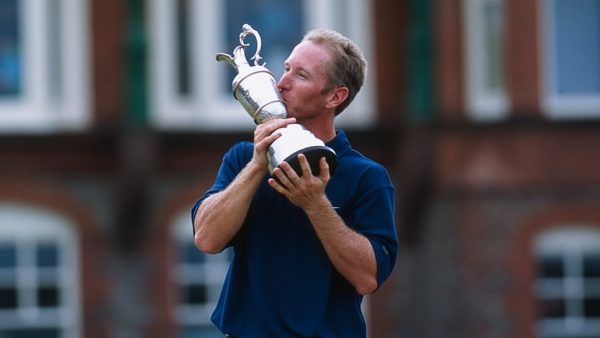
2001 – DAVID DUVAL

Duval’s closing rounds of 65-67 in dappled sunshine and little wind were textbook; he attacked the par-5s especially. And again, Ernie Els threatened, ultimately finishing third behind Duval’s masterful weekend surge. But poor Ian Woosnam will always be remembered as the hard luck story of this tournament, as his caddie left two drivers in the bag resulting in a crippling 2-shot penalty for 15 clubs, turning Woosy’s scintillating opening birdie (almost a hole-in-one!) into the most dispiriting bogey one could imagine.
Woosnam practicing with an extra driver was one problem, but an ill-timed bathroom run may have been the other. Nature called poor Simon Byrne right before tee time, and he was racing to the tee (some say still buckling his pants in the process) with Woosnam’s bag and plum forgot about the extra club until the second tee box when Woosy asked for the driver.
“Ian, you’re gong to go ballistic…” came the response.
“I gave you one job, and you couldn’t do it,” was the mournful reply. Woosnam finished three back of Duval.
2012 – ERNIE ELS
Adam Scott fell out of the sky. That’s the only way to describe it. Yes, Els birdied 18 four groups in front of Scott, but after Scott birdied 14, the Aussie had a four-shot lead with four holes to play. Yes, four shots can be “one bad swing and one bad decision,” but Scott’s was a slow-motion execution. With not one Claret Jug, but pretty much both, he bogeyed 15, 16, 17, and 18, an ecpyrosis as horrifying as Phil Mickelson’s epic collapse at Winged Foot in the 2006 U.S. Open. Missed short putts! Clubbing down, but finding bunkers anyway! And enough mistakes early in the round that he should hav e been leading by 14, not four.
Still, Els hung tough. He set the clubhouse mark and, as happens sometimes, it turned out to be good enough. It was his second Claret jug in 10 years, the previous after winning a four-man playoff at Muirfield. That’s the second longest gap between Open victories, behind only the great Henry Cotton.
In sum, shotmakers, not bombers, win at Lytham. It demands planning, execution, precision, and patience. But most of all, it requires love: a love of links golf, an inner peace to embrace the whimsies of links golf, and a passion for all the glorious golf history of the club. Lytham is singular, it stands unique in the world of golf for its charming idiosyncrasies. Love Lytham for Lytham, and she love you back. All golf waits, enchanted and mesmerized, to see her next 100 years.